- Imagine a person is having difficulty hearing and visits a hospital.
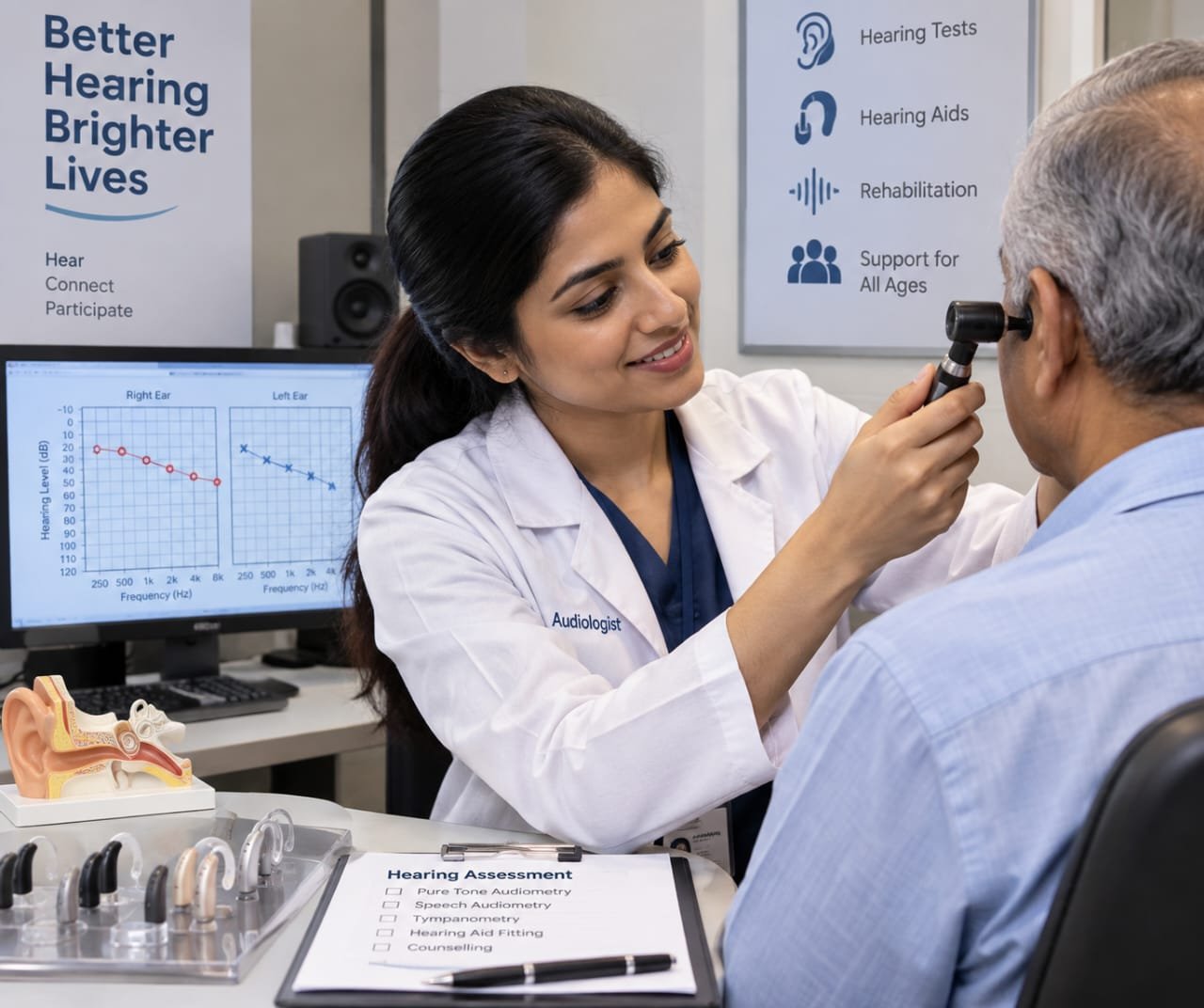
- The Audiologist first talks to the person and asks about their hearing problem.
- They then perform some hearing tests to find out how well the person can hear.
- After the tests, the Audiologist checks the results and identifies the hearing problem.
- They suggest the right solution to the problem.
- 👉 In simple words: An Audiologist is a person who checks hearing, finds hearing problems, and helps people with hearing loss.
Audiologist
What Do They Do?
🎓 How to Become an Audiologist
The courses to pursue this career are given below :
After completing Class 12, you can pursue diploma or bachelor's degree courses in speech, language, and hearing to learn about communication disorders and their management.
Diploma in Hearing, Language and Speech (DHLS)
Duration: 1 Year
Eligibility: 12th Pass with Physics, Chemistry, and Biology/Mathematics (Minimum 50% Marks)
Entrance Exam: Direct Admission / Institute-Level Entrance Exam (e.g., AIISH All India Entrance)
Bachelor of Audiology and Speech-Language Pathology (BASLP)
Duration: 4 Years (3 Years Academic + 1 Year Internship)
Eligibility: 12th Pass with Physics, Chemistry, and Biology/Mathematics (Minimum 50% Marks)
Entrance Exam: AIISH Entrance Exam / CUET UG / State CETs / University Entrance Exams
📝 Exam Details
(Click on the exam name to see full details)
State Paramedical Entrance Exams State Level CET AIISH Entrance Exam CUET UG University Entrance Exams Merit-Based AdmissionNote: Admission requirements and entrance procedures may vary between institutions and states.
After completing a relevant bachelor's degree, you can pursue postgraduate courses in speech-language pathology or audiology to develop advanced skills in communication and hearing care.
Master in Speech-Language Pathology (MASLP)
Duration: 2 Years
Eligibility: BASLP or B.Sc. in Speech and Hearing degree recognized by RCI (Minimum 50% Marks)
Entrance Exam: University PG Entrance Exams (e.g., AIISH All India Entrance, Manipal MET PG) State Medical University Exams
Master of Science in Audiology (M.Sc. Audiology)
Duration: 2 Years
Eligibility: BASLP degree recognized by RCI (Minimum 50% Marks)
Entrance Exam: University PG Entrance Tests
📝 Exam Details
(Click on the exam name to see full details)
University PG Entrance Exams Merit-Based Admission State Medical University ExamsNote: Admission requirements and entrance procedures may vary between institutions and states.
Note:
(Age limits, marks, and admission process may vary depending on the college or state.
Below are some colleges that offer these courses.
These courses are available in many colleges and universities across India. You can choose colleges based on your location, budget, and entrance exams.)
Colleges offering these courses in India
(Tap on a college to view the details)
After Class 12
All India Institute of Speech and Hearing (AIISH), Mysuru, Karnataka Ali Yavar Jung National Institute of Speech and Hearing Disabilities (AYJNISHD), Mumbai National Institute of Speech & Hearing (NISH), Thiruvanathapuram, Kerala National Institute of Empowerment of Persons with Multiple Disabilities (NIEPMD), Chennai, Tamil NaduAfter Graduation
Manipal College of Health Professions (MCHP), Manipal, Karnataka SRM Institute of Science & Technology (SRMIST), Kattankulathur, Tamil Nadu All India Institute of Speech and Hearing (AIISH), Mysuru, Karnataka Nitte Institute of Speech & Hearing (NISH), Mangaluru, Karnataka Sri Ramachandra Institute of Higher Education and Research (SRIHER), Chennai, Tamil NaduSTEP 1
Imagine you are working as an Audiologist in a hospital.
STEP 2
A person visits the hospital because they are having difficulty hearing.
STEP 3
You talk to the person and ask about their hearing problem.
STEP 4
You perform hearing tests to check how well they can hear.
STEP 5
You check the test results to understand the hearing problem.
STEP 6
You explain the problem to the person in simple words.
STEP 7
You suggest the right solution based on their hearing needs.
STEP 8
If needed, you give a hearing aid for the person.
STEP 9
You teach the person how to use it and do follow-up care.
STEP 10
👉 If you like helping people with hearing problems and working in healthcare, this career may suit you.
Hospitals
Check patients' hearing and help manage hearing problems.
Hearing & Speech Centres
Perform hearing tests and provide hearing-related care.
ENT Clinics
Work with ENT doctors to assess and manage hearing problems.
Speciality Hospitals
Provide hearing assessments and care for patients with different hearing conditions.
Hearing Aid Centres
Test hearing, recommend hearing aids, and help patients use them properly.
Rehabilitation Centres
Provide hearing rehabilitation and support for people with hearing loss.
Medical Colleges
Work in teaching hospitals and help train students in Audiology.
Government & Private Hospitals
Provide hearing assessment, hearing rehabilitation, and follow-up care.
(Click Yes or No for each question)
1. Do you like talking to people and helping them with their hearing problems?
2. Are you interested in learning about how hearing problems are identified?
3. Sometimes, people may find it difficult to understand their hearing problem and may ask you the same questions again. Would you be comfortable explaining it patiently?
4. Imagine a person is having difficulty hearing. You perform different hearing tests to find out what is causing the problem and how severe it is. You then explain the results and suggest the right solution. Would you be interested in doing this kind of work?
5. Imagine a person is using a hearing aid but is still having difficulty hearing clearly. You need to check the hearing aid, make the right adjustments, and help the person use it properly. Does doing this kind of work makes you happy?