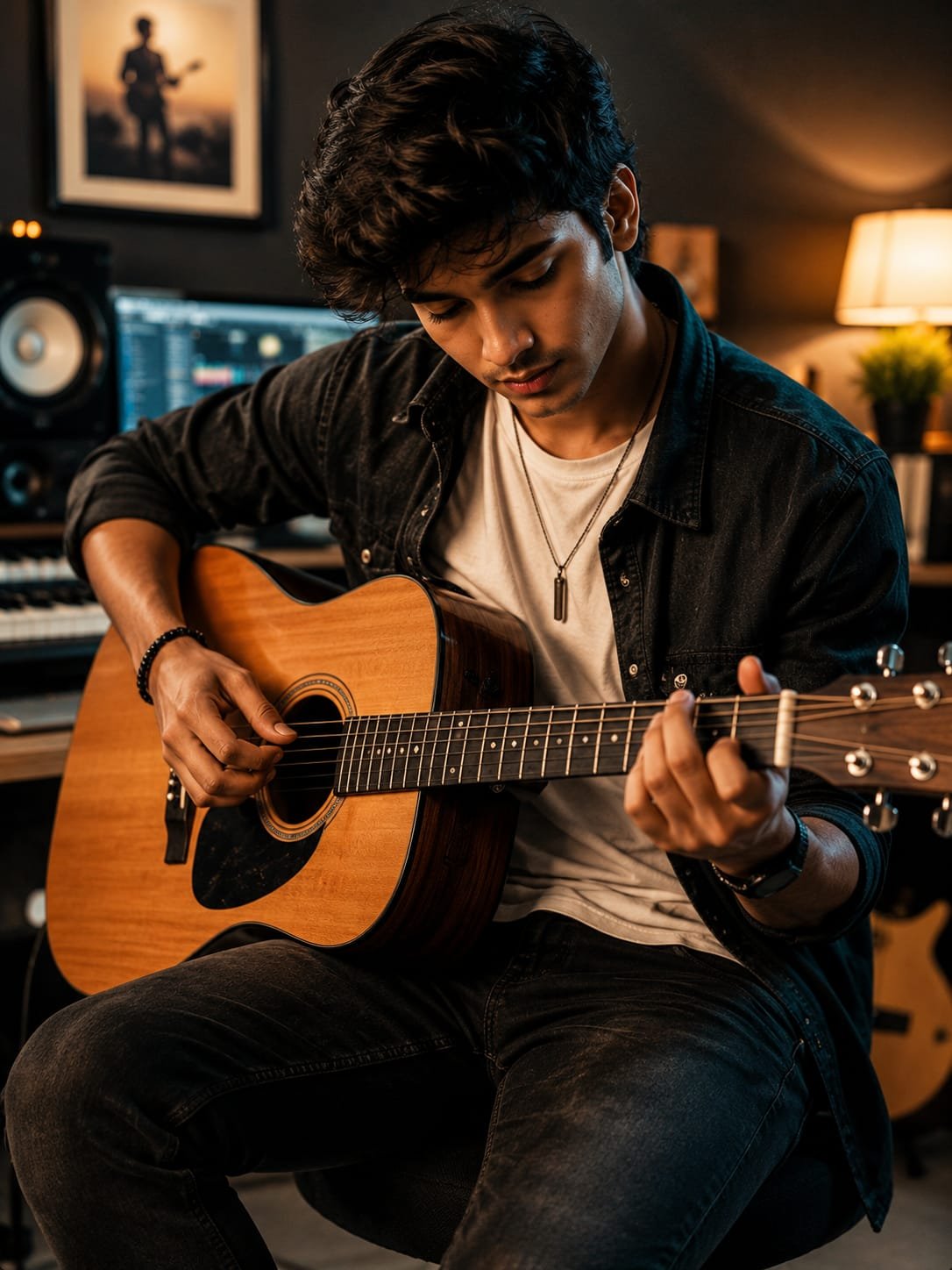
- Imagine a singer is performing a song on stage or in a studio.
- Someone is playing the musical instruments like guitar, keyboard, drums, or violin on the background to create the music.
- That person is called an Instrumentalist.
- 👉 In simple words: Instrumentalists play musical instruments for songs, concerts, recordings, and performances.
Instrumentalist
What Do They Do?
🎓 How to Become an Instrumentalist
There is no compulsory course to become an instrumentalist.
You can learn the musical instrument of your choice (piano, guitar, violin etc...) from an experienced teacher or a music academy.
Degree courses and certifications can help you build your knowledge and advance your career.
These undergraduate music courses help students improve instrumental performance, music theory, composition, stage confidence, live performance skills, and professional musical techniques.
Bachelor of Arts (B.A.) in Music (Instrumental)
Duration: 3 Years
Eligibility: Class 12 Pass
Entrance Exam: Merit-Based / University Entrance Exam / Practical Audition (Varies by College)
Bachelor of Arts (B.A.) in Instrument
Duration: 3 Years
Eligibility: Class 12 Pass
Entrance Exam: Merit-Based / University Entrance Exam / Practical Audition (Varies by College)
Bachelor of Performing Arts (BPA)
Duration: 3 - 4 Years
Eligibility: Class 12 Pass
Entrance Exam: Practical Audition / University Entrance Exam / Merit-Based Admission (Varies by College)
📝 Exam Details
(Click on the exam name to see full details)
University Entrance Exam Practical Audition Merit Based AdmissionNote: Most music degree programs after 12th mainly focus on practical instrumental skills, live performance ability, rhythm training, creativity, and musical expression.
- After learning a musical instrument from a teacher or music academy, you can take certification examinations conducted by recognized music boards.
- These certifications help you assess your skills and progress to higher levels.
- Some of the prominent music boards and institutions offering instrumental music certifications are listed below.
- Some of the popular online platforms for learning musical instruments are listed below.
🏛️ Institutes offering these courses in India
(Tap on an institute to view the details)
After 12th Pass (Bachelor's Degrees)
RLV College of Music & Fine Arts, Ernakulam Jawahar Lal Nehru Govt College of Fine Arts, Shimla Maharaja Sayajirao University of Baroda Asian Academy of Film & Television, Noida Parul University, VadodaraSTEP 1
Imagine you love playing musical instruments like guitar, keyboard, or drums.
STEP 2
You practice music every day and learn new songs and melodies.
STEP 3
One day, your school or a local event invites you to perform on stage.
STEP 4
You play your instrument confidently and the audience enjoy the music.
STEP 5
People appreciate your performance and you get opportunities to perform in concerts and studios.
STEP 6
If you enjoy music, creativity, and playing instruments, this career may suit you.
Where do Instrumentalists work? (Job Roles + Growth)
Instrumentalists work in : Concerts and live shows, Music recording studios, Film and music industry, TV shows and media, YouTube and social media, Music schools and academies, Music bands and orchestras, and international music events and festivals.
🔵 Beginner Roles
Session Musician
Play instruments for songs, recordings, and small music projects.
Live Performer
Perform instruments at small concerts, stage shows, and events.
Music Instructor
Teach basic instrument skills to music students.
🟣 Mid-Level Roles
Studio Musician
Record instrumental parts for songs, albums, films, and other projects.
Band Musician
Perform regularly with bands at concerts, events, and music shows.
Film Musician
Play instruments for film songs, background scores, and other productions.
🟢 Advanced Roles
Professional Session Musician
Work on major recordings with composers, singers, and music directors.
Orchestra Musician
Perform with professional orchestras for concerts, films, and major productions.
International Performer
Perform in international concerts, music festivals, tours, and productions.
International Film & Music Industry
Perform and record music for movies, albums, and web series.
Live Concerts & Music Tours
Perform in concerts, festivals, and international music events.
Recording Studios & Music Labels
Work with singers, bands, and music producers in studios.
YouTube & Digital Platforms
Share instrumental performances and grow a global audience online.
(Click Yes or No for each question)
1. Do you like listening to music?
2. Are you interested in learning a musical instrument?
3. Have you ever thought of creating your own music?
4. Imagine you are working as an Instrumentalist in a music group. The group is preparing for a live program, and you are playing the keyboard. You practise the song with the other musicians. You make sure your playing matches the music. When the program begins, you perform the song with the group in front of the audience. Do you like this type of work?
5. A singer is recording a new song in a music studio. You are asked to play the keyboard for the song. You practise the music and play the keyboard while the singer records the song. Finally, the song is completed with the music you played. Does this type of work interest you?