- Imagine a person is admitted to a hospital because they are not feeling well.
- A blood sample is collected and sent to the laboratory for testing.
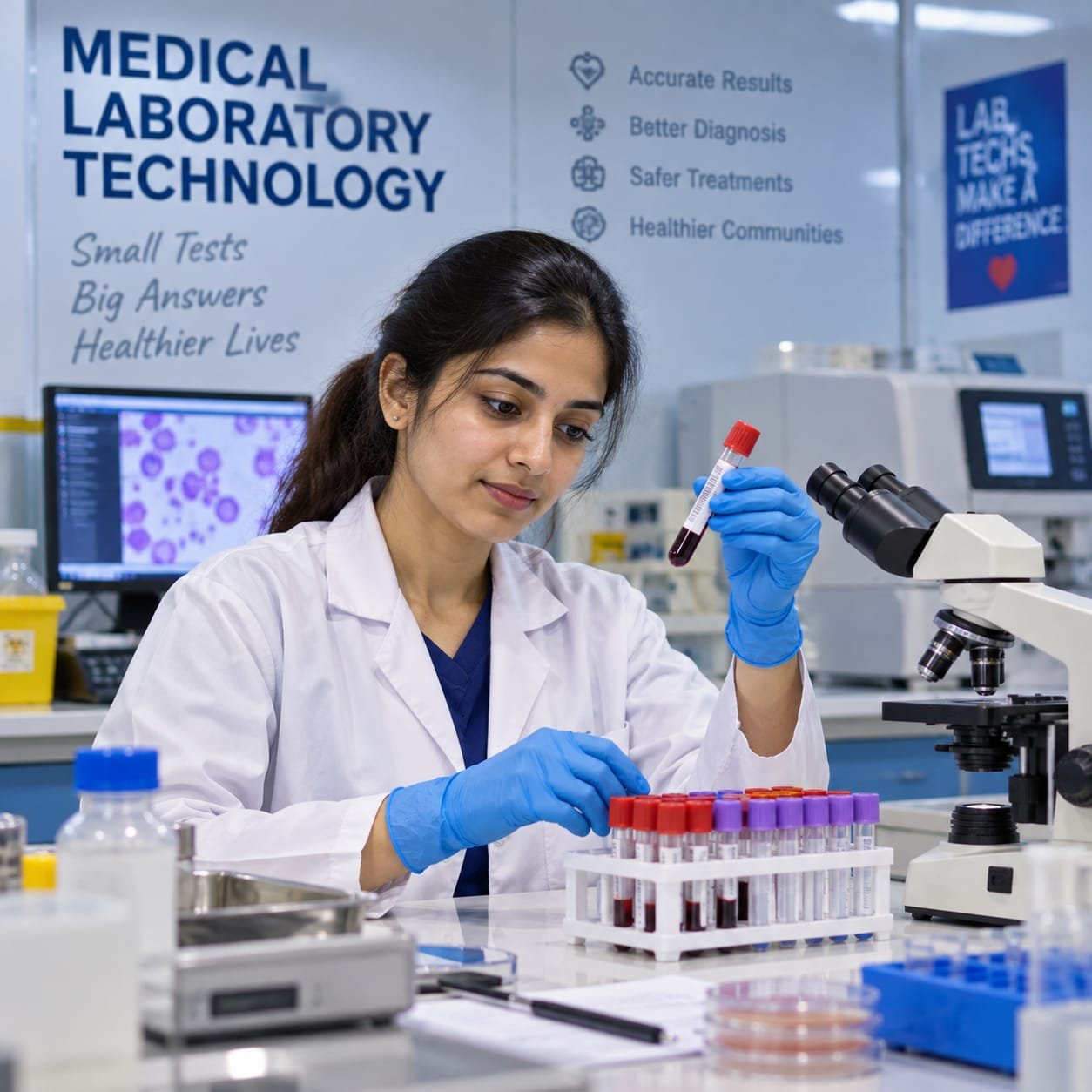
- In the laboratory, someone performs different tests, examines the samples, and shares the findings with the medical team.
- The person who performs this laboratory work is called a Medical Laboratory Technologist.
- 👉 In simple words: They test blood, urine, and other samples in medical laboratories.
Medical Laboratory Technologist
What Do They Do?
🎓 How to Become a Medical Laboratory Technologist
The courses to pursue this career are given below :
After completing 12th, you can pursue diploma or degree courses in medical laboratory technology to build the knowledge and practical skills needed to work in medical laboratories.
Diploma in Medical Laboratory Technology (DMLT)
Duration: 2 Years
Eligibility: 10+2 with Physics, Chemistry and Biology
Entrance Exam: State Paramedical Entrance Exams / Institute Specific Test / Merit-based admission
B.Sc. in Medical Laboratory Technology (B.Sc. MLT)
Duration: 3–4 Years (including internship)
Eligibility: 10+2 with Physics, Chemistry and Biology (min mark varies by college)
Entrance Exam: CUET-UG / State Paramedical Entrance Exam / Institute-Specific Test / Merit-Based Admission
📝 Exam Details
(Click on the exam name to see full details)
State Paramedical Exam Institute Specific Test CUET Merit Based AdmissionNote: Top colleges require entrance exams, while some colleges offer admission based on merit or institute-level tests.
After graduation, you can pursue advanced courses in medical laboratory technology to develop specialized knowlegde and skills in areas such as pathology, microbiology and biochemistry.
M.Sc. Medical Laboratory Technology (M.Sc. MLT)
Duration: 2 Years
Eligibility: B.Sc. Medical Laboratory Technology (B.Sc. MLT) or an equivalent degree, as specified by the institution
Entrance Exam: University/Institute-Specific Entrance Exam / Merit-Based Admission
Post Graduate Diploma in Medical Laboratory Technology (PGDMLT)
Duration: 1 Year
Eligibility: B.Sc. Medical Laboratory Technology (B.Sc. MLT) or a relevant Science/Applied Science degree, as specified by the institution
Entrance Exam: University/Institute-Specific Entrance Exam / Merit-Based Admission
📝 Exam Details
(Click on the exam name to see full details)
Institute Specific Test University Entrance Exams Merit Based AdmissionNote: Advanced courses focus on specialization.
Note:
(Age limits, marks, and admission process may vary depending on the college or state.
Below are some colleges that offer these courses.
These courses are available in many colleges and universities across India. You can choose colleges based on your location, budget, and entrance exams.)
Colleges offering these courses in India
(Tap on a college to view the details)
After Class 12
Christian Medical College, Chittoor, Andra Pradesh Lovely Professional University (LPU), Phagwara, Punjab Brainware University, Kolkata, West Bengal Amrita Vishwa Vidyapeetham, Faridabad, Haryana Chandigarh University, Mohali, Punjab Manipal College of Health Professions (MCHP), Manipal, KarnatakaSTEP 1
Imagine you are working as a Medical Laboratory Technologist in a laboratory.
STEP 2
Patient samples such as blood and urine arrive at the laboratory.
STEP 3
You check the samples and their labels carefully.
STEP 4
The samples are prepared for testing.
STEP 5
Different tests are performed using laboratory equipment.
STEP 6
You examine the test results.
STEP 7
The results are recorded and the findings are shared with the medical team.
STEP 8
If you enjoy science, laboratory work, and careful testing, this career may suit you.
Government Hospitals & Health Centres
Test patient samples and record laboratory findings.
Private Hospitals
Perform laboratory tests on blood, urine and other patient samples.
Private Laboratories
Perform tests on blood, urine and other patient samples.
Diagnostic Laboratories
Collect, prepare and test different types of patient samples.
Medical Colleges
Perform laboratory tests and support medical teaching and training.
Blood Banks
Test blood samples for blood groups and other required checks.
Research Centres
Examine samples and assist with medical and health-related research.
Public Health Laboratories
Test samples to help detect and monitor diseases in the community.
Abroad Opportunities
Perform laboratory testing in hospitals, diagnostic labs and other healthcare settings.
(Click Yes or No for each question)
1. Would you like to work with blood and urine samples?
2. Do you like working in a laboratory?
3. Can you stay focused on a task until it is finished?
4. Imagine you are working as a Medical Laboratory Technologist. You receive a blood sample from a patient. You examine the sample and perform tests to find out what is present in the blood. Would you enjoy doing this kind of work?
5. You are working in a hospital. A patient's blood sample comes to the laboratory. You label it, prepare it, perform the required tests, and record the results. Would you enjoy doing this kind of work?