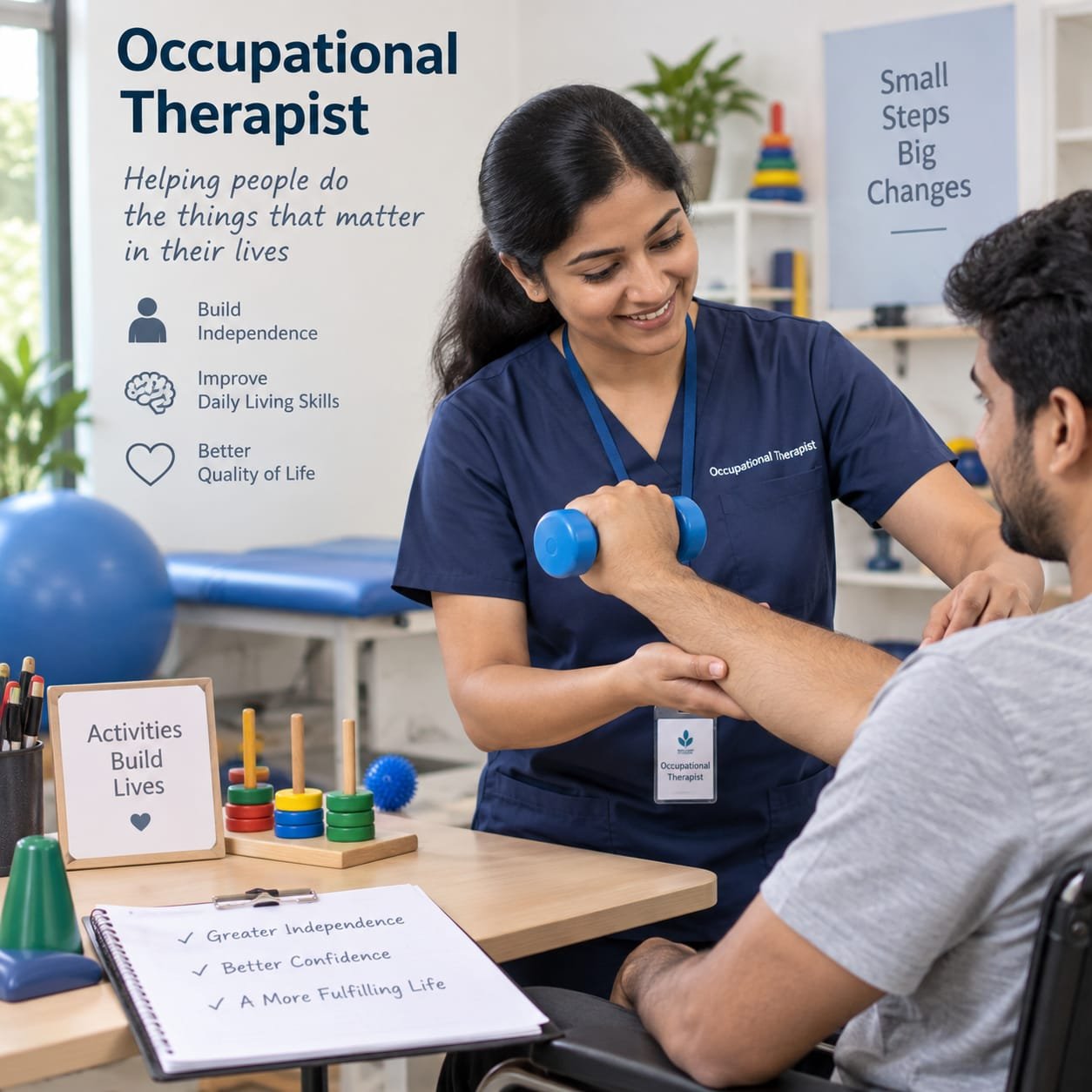
- Imagine a person has injured their hand and finds it difficult to eat with a spoon.
- The Occupational Therapist checks what is causing the difficulty.
- They find that the person's hand is weak and difficult to move.
- The therapist gives simple exercises and activities to improve the hand movement.
- They guide the person and check their progress.
- Slowly, the person gets better at using their hand and eating on their own.
- 👉 In simple words: An Occupational Therapist helps people overcome difficulties in doing everyday activities.
Occupational Therapist
What Do They Do?
🎓 How to Become an Occupational Therapist
The courses to pursue this career are given below :
After completing Class 12, you can pursue a degree in occupational therapy to learn how to assess patients, provide therapy, and help people become more independent in their daily activities.
Bachelor of Occupational Therapy (BOT)
Duration: 5 Years (4 Years Academic + 1 Year Internship)
Eligibility: 10+2 Pass with Physics, Chemistry, and Biology
Entrance Exams: NEET-UG / State Entrance Exams / University Entrance Exams
📝 Exam Details
(Click on the exam name to see full details)
NEET-UG State CET Exam University Entrance ExamsNote: Admission requirements, eligibility, entrance procedures, and selection criteria may vary between institutions and states.
After completing a Bachelor of Occupational Therapy (BOT), you can pursue a master's degree in occupational therapy to gain advanced knowledge and skills in rehabilitation and specialised areas of occupational therapy.
Master of Occupational Therapy (MOT)
Duration: 2 Years
Eligibility: Bachelor of Occupational Therapy (BOT) from a recognised university
Entrance Exams: University PG Entrance Exams / CAHET / SVNIRTAR PGET / CUET-PG / Merit Based Admission / Institutional Entrance Test
📝 Exam Details
(Click on the exam name to see full details)
University PG Entrance Exams CAHET SVNIRTAR PGET Institutional Entrance Test Merit Based AdmissionNote: Admission requirements, eligibility, entrance procedures, and selection criteria may vary between universities.
Note:
(Age limits, marks, and admission process may vary depending on the college or state.
Below are some colleges that offer these courses.
These courses are available in many colleges and universities across India. You can choose colleges based on your location, budget, and entrance exams.)
Colleges offering these courses in India
(Tap on a college to view the details)
After Class 12
Christian Medical College (CMC) Vellore, Tamil Nadu National Institute of Empowerment of Persons with Multiple Disabilities (NIEPMD), Chennai, Tamil Nadu Manipal College of Health Professions (MCHP), Manipal, Karnataka Swami Vivekanand National Institute of Rehabilitation Training and Research (SVNIRTAR), Cuttack, OdishaSTEP 1
Imagine you are working as an Occupational Therapist in a hospital.
STEP 2
A patient comes to you because they are having difficulty walking after an illness or injury.
STEP 3
You check the patient to find out what is making their daily activities difficult.
STEP 4
You identify the problems.
STEP 5
You plan exercises and activities to help the patient improve their walking.
STEP 6
You guide the patient while doing these exercises and activities.
STEP 7
You help the patient practise these activities everyday.
STEP 8
You check the patient's progress and change the activities if needed.
STEP 9
👉 If you like helping people with their movements and daily actvities, this career may suit you.
Hospitals
Help patients improve their ability to do everyday activities.
Rehabilitation Centres
Help people recover their skills after illness, injury, or disability.
Speciality Hospitals
Work with patients who need specialised rehabilitation and support.
Paediatric Centres
Help children improve skills needed for everyday activities.
Mental Health Centres
Help people manage daily activities and become more independent.
Nursing Homes & Care Centres
Help older people stay active and manage their daily activities.
Medical Colleges
Work in teaching hospitals and help train students in Occupational Therapy.
Government & Private Hospitals
Provide occupational therapy and rehabilitation services to patients.
(Click Yes or No for each question)
1. Do you like helping people who are having difficulty doing everyday activities?
2. Are you interested in learning about exercises that can help people improve?
3. Sometimes, patients may find it difficult to do an activity even after several attempts. Do you have the patience to help them do this again and again?
4. Imagine a patient is having difficulty walking came to the hospital. You check the patient properly and find out the problem. You plan exercises to help them improve walking. You guide the patient while doing these exercises. Would you be interested in doing this kind of work?
5. One of your patients has improved but still finds some daily activities difficult to do. You need to find new ways to help them. You give them new exercies to do daily. After few days, patient start getting better. Does this kind of work makes you happy?