- Have you ever wondered how an airplane fly through the sky?
- Airplanes must be designed carefully to fly safely.
- They must be strong, balanced, and able to handle different weather conditions.
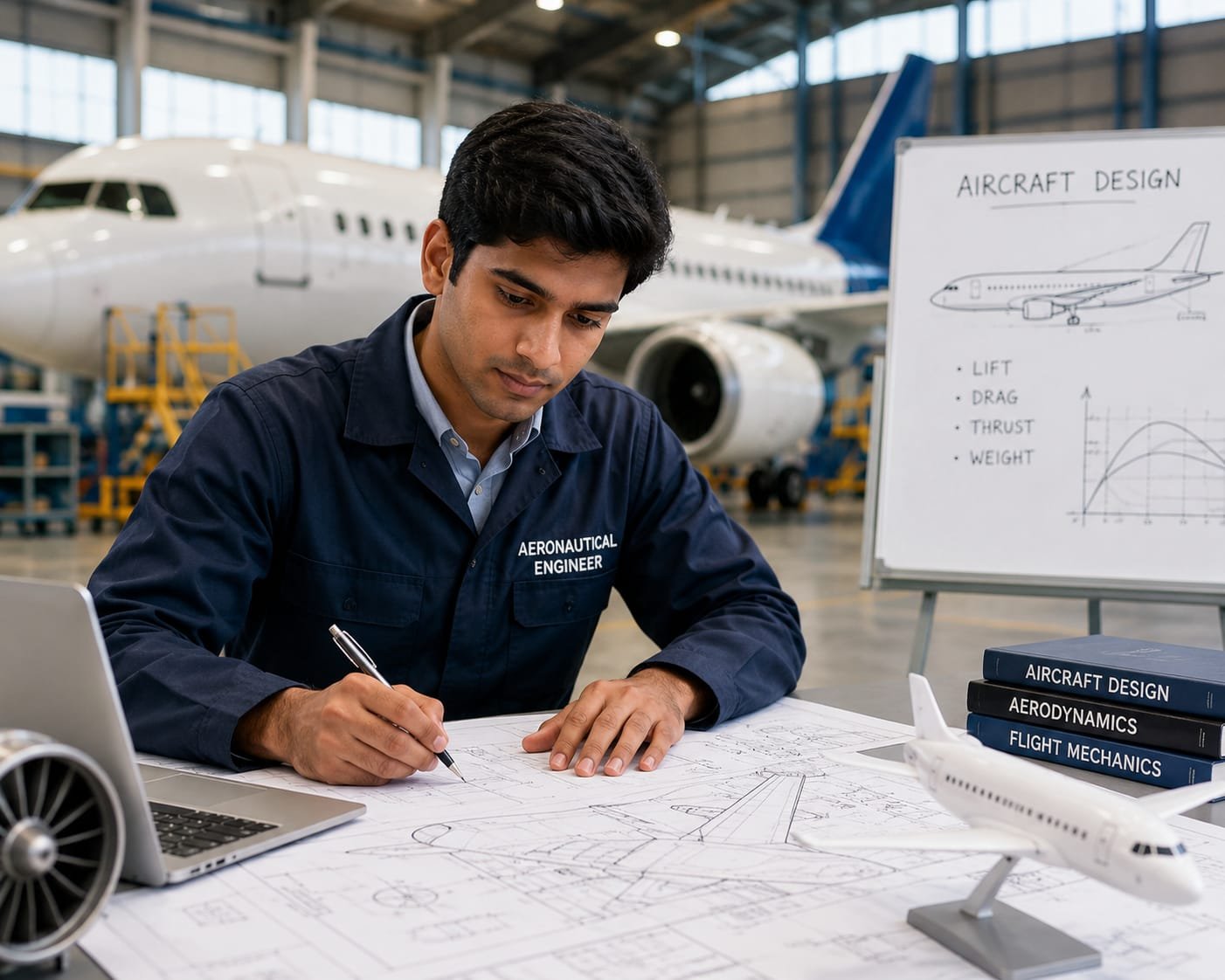
- The person who helps design and test these aircraft is called an Aeronautical Engineer.
- 👉 In simple words: Aeronautical Engineers design, test, and improve aircraft.
Aeronautical Engineer
What Do They Do?
🎓 Courses to Become an Aeronautical Engineer
You have two options:
-
Start early with a Diploma
After Class 10, you can choose a relevant diploma course. Complete the diploma and join the second year of an engineering course by applying through lateral entry. -
Finish Class 12
Complete Class 11 and 12, then you can do a B.Tech./B.E. in the relevant field.
After completing 10th, you can start your journey in aeronautical engineering through diploma-level courses.
Diploma in Aeronautical Engineering
Duration: 3 Years (6 semesters)
Eligibility: Pass in Class 10 (SSC) from a recognized board
Entrance Exam: AME CET / State Polytechnic Entrance Exams (like JEECUP, JEXPO)
📝 Exam Details
(Click on the exam name to see full details)
AME CET (National Level) State Polytechnic Entrance ExamsMerit Based: Some colleges offer admission without entrance exams.
After completing 12th with PCM, you can pursue a degree in aeronautical engineering to build strong technical knowledge in aircraft design and flight systems.
B.Tech / B.E. in Aeronautical Engineering
Duration: 4 Years (8 semesters)
Eligibility: 10+2 with Physics, Chemistry, and Mathematics (PCM)
Entrance Exam: JEE Main / JEE Advanced / University Level Exams(BITSAT, VITEEE) / State CETs (KCET, MHT CET)
📝 Exam Details
(Click on the exam name to see full details)
JEE Main JEE Advanced University Entrance Exams State Level CET ExamsAfter completing a diploma, you can directly enter the 2nd year of an engineering degree through lateral entry and continue your journey in aeronautical engineering.
B.Tech (Direct 2nd Year Entry)
Duration: 3 Years
Eligibility: 3-year Diploma in Aeronautical, Mechanical, or related field
Entrance Exam: State Lateral Entry Exams (LEET, JELET, OJEE)
Merit Based: Some colleges offer admission without entrance exams.
After graduation, you can specialize further in aeronautical or aerospace engineering to gain advanced knowledge in aircraft design, aerodynamics, and flight systems.
M.Tech / M.E. in Aeronautical Engineering
Duration: 2 Years
Eligibility: B.E. / B.Tech in Aeronautical, Aerospace, or related field
Entrance Exam: GATE
Merit Based: Some colleges offer admission without entrance exams.
Note:
(Age limits, marks, and admission process may vary depending on the college or state.
Below are some colleges that offer these courses.
These courses are available in many colleges and universities across India. You can choose colleges based on your location, budget, and entrance exams.)
🏛️ Colleges offering these courses in India
(Tap on a college to view the details)
After Class 12
Manipal Institute of Technology, Manipal, Karnataka Anna University, MIT Campus, Chennai Institute of Aeronautical Engineering (IARE), Hyderabad, Telangana ACE College of Engineering, Trivandrum, KeralaSTEP 1
Imagine you are working as an Aeronautical Engineer.
STEP 2
Your team is designing a new airplane.
STEP 3
You help create the aircraft design and choose suitable materials.
STEP 4
You test whether the aircraft can fly safely and efficiently.
STEP 5
The aircraft is built and used to carry passengers safely around the world.
STEP 6
If you enjoy aircraft, science, and solving problems, this career may be right for you.
Where do Aeronautical Engineers work? (Job Roles + Growth)
Aernautical Engineers work in : Aircraft manufacturing companies, Airlines, Aerospace companies, Aircraft maintenance organizations, Defence organizations, Airports, Aviation research laboratories, and Government aerospace agencies.
🟢 Beginner Roles
Junior Aircraft Technician
(After Diploma / AME)
Checks and repairs aircraft parts.
Graduate Engineer Trainee
(After B.Tech)
Assists senior engineers on aircraft projects.
🔵 Mid-Level Roles
Aeronautical Engineer
(After B.Tech + Experience)
Designs and tests aircraft.
Aircraft Structural Engineer
(After B.Tech + Experience)
Designs strong and safe aircraft bodies.
🟣 Advanced Roles
Chief Flight Test Engineer
(After M.Tech / Advanced Specialization)
Leads aircraft flight testing.
VP of Aerospace Engineering
(After Executive Program + Experience)
Leads large aerospace engineering teams.
Aircraft Manufacturing Companies
Design and build airplanes.
Helicopter & Drone Companies
Develop helicopters and drones.
Space & Aerospace Organizations
Work on rockets, satellites, and spacecraft.
Defence Aviation Organizations
Develop military aircraft and aviation systems.
Aircraft Maintenance Companies
Inspect and improve aircraft safety.
Research Organizations
Create new aviation technologies.
(Click Yes or No for each question)
1. Have you ever wondered how airplanes stay in the sky without falling?
2. Do you like to learn how airplanes are flying?
3. Would you like to know how airplanes are made?
4. Imagine you are working as an Aeronautical Engineer for an aircraft company. Your job is to help design the aircraft. You test different parts and make sure the airplane is safe and can fly efficiently. Are you interested in doing this?
5. An airline company is testing its new airplane. During the test, engineers find out that one part of the airplane is not working properly. They check the airplane and find out the problem and fix it. Do you like this kind of work?