- When you visit a hospital, you may have seen machines like heart monitors, scanners, or X-ray machines.
- These devices help doctors to check and treat patients better.
- Have you ever wondered who designs these machines?
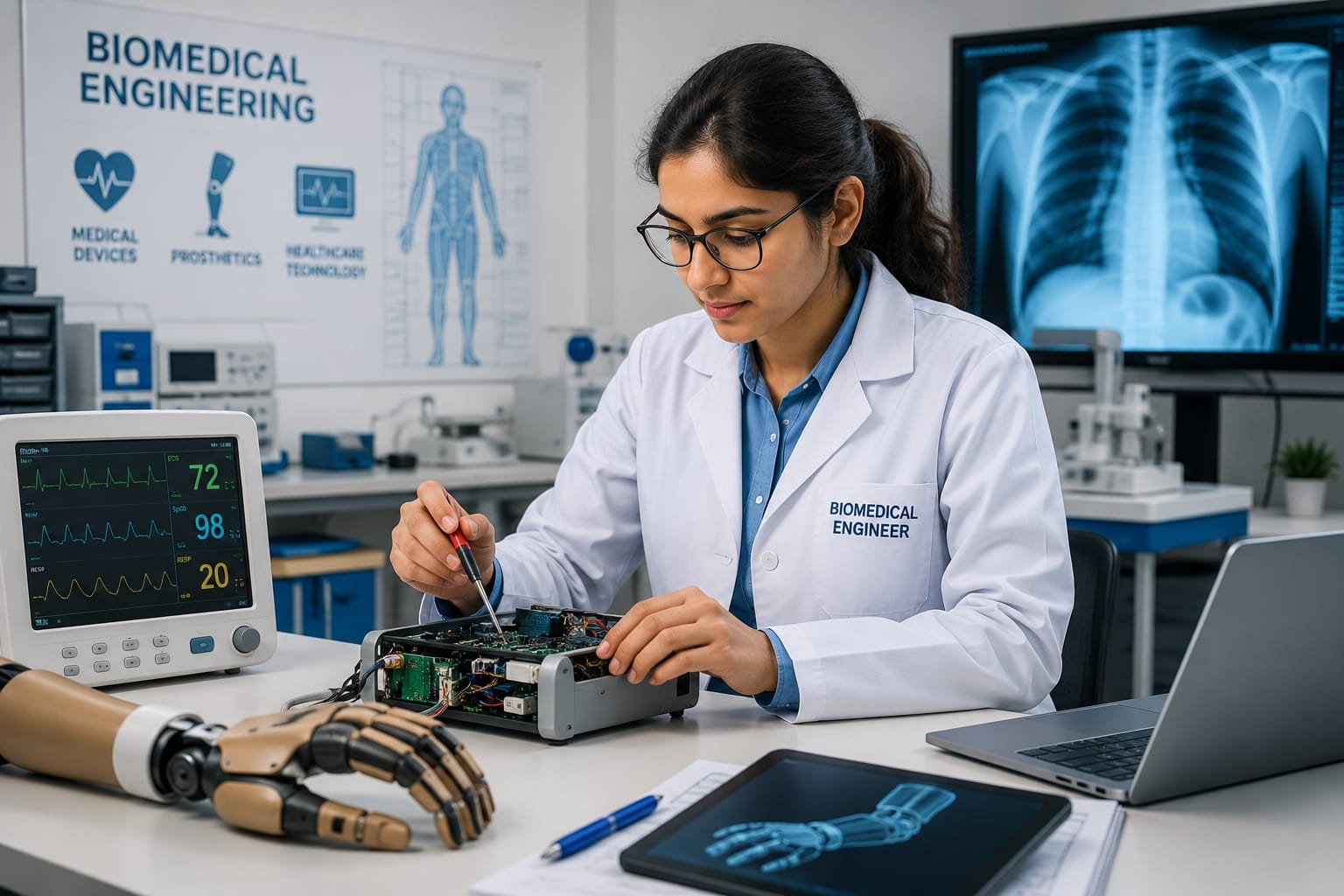
- The person who designs, develop and improves such medical devices is called a Biomedical Engineer.
- 👉 In simple words: Biomedical Engineers design machines and devices that help doctors treat patients.
Biomedical Engineer
What Do They Do?
🎓 How to Become a Biomedical Engineer
You have two options:
-
Start early with a Diploma
After Class 10, you can choose a relevant diploma course. Complete the diploma and join the second year of an engineering course by applying through lateral entry. -
Finish Class 12
Complete Class 11 and 12, then you can do a B.Tech./B.E. in the relevant field.
These diploma courses help students learn medical equipment, hospital technologies, biomedical devices, and healthcare engineering systems.
Diploma in Biomedical Engineering
Duration: 3 Years
Eligibility: 10th Pass with Science and Mathematics (Minimum 35%–50% marks)
Entrance Exam: State Polytechnic Entrance Exams
Diploma in Medical Electronics Engineering
Duration: 3 Years
Eligibility: 10th Pass with Science and Mathematics (Minimum 35%–50% marks)
Entrance Exam: State Polytechnic Entrance Exams
Note: Students who complete these diploma programs can work with medical equipment, hospital technology systems, healthcare device maintenance, and biomedical laboratories, or continue higher studies in Biomedical Engineering.
These degree programs help students learn medical devices, healthcare technology, biomedical systems, and medical equipment design.
B.Tech / B.E. in Biomedical Engineering
Duration: 4 Years
Eligibility: 10+2 with PCM or PCB (Minimum 50%–60% aggregate)
Entrance Exam: JEE Main / JEE Advanced /State-Level Engineering Entrance Exams / University Entrance Exams
B.Tech in Medical Electronics Engineering
Duration: 4 Years
Eligibility: 10+2 with PCM or PCB (Minimum 50%–60% aggregate)
Entrance Exam: JEE Main / State-Level Engineering Entrance Exams (e.g., KCET) / University Entrance Exams (e.g., COMEDK, VITEEE)
📝 Exam Details
(Click on the exam name to see full details)
JEE Main JEE Advanced State Engineering Entrance Exams University Entrance ExamsNote: These programs prepare students for careers in medical device design, healthcare technology, hospital equipment systems, diagnostic machines, and biomedical research.
These lateral entry programs help diploma holders continue their studies in biomedical devices, healthcare technology, medical electronics, and hospital equipment systems.
B.Tech Lateral Entry in Biomedical Engineering
Duration: 3 Years (Direct admission into 2nd year)
Eligibility: 3-year Engineering Diploma in a relevant stream (Minimum 45%–50% marks)
Entrance Exam: State Lateral Entry Entrance Tests (e.g., TS ECET, AP ECET, JELET, OJEE LE)
B.Tech Lateral Entry in Medical Electronics Engineering
Duration: 3 Years (Direct admission into 2nd year)
Eligibility: 3-year Engineering Diploma in a relevant stream (Minimum 45%–50% marks)
Entrance Exam: State Lateral Entry Entrance Tests (e.g., TS ECET, AP ECET, JELET, OJEE LE)
Note: Diploma holders can enter directly into the second year of B.Tech programs and specialize in biomedical devices, medical electronics, diagnostic equipment, and healthcare technology systems.
These postgraduate programs help students specialize in medical devices, medical imaging systems, healthcare technology, and advanced biomedical research.
M.Tech / M.E. in Biomedical Engineering
Duration: 2 Years
Eligibility: B.E. / B.Tech in Biomedical, Biotechnology, Electronics, or Mechanical Engineering (Minimum 50%–60% aggregate)
Entrance Exam: GATE / CUET PG
M.Tech in Medical Devices
Duration: 2 Years
Eligibility: B.E. / B.Tech in Biomedical, Biotechnology, Electronics, or Mechanical Engineering (Minimum 50%–60% aggregate)
Entrance Exam: GATE / CUET PG
Note: These programs prepare students for careers in medical device research, healthcare technology development, medical imaging systems, biomedical product design, and advanced biomedical engineering roles.
Note:
(Age limits, marks, and admission process may vary depending on the college or state.
Below are some colleges that offer these courses.
These courses are available in many colleges and universities across India. You can choose colleges based on your location, budget, and entrance exams.)
🏛️ Colleges offering these courses in India
(Tap on a college to view the details)
After Class 10
Parul University, Vadodara, Gujarat Government Polytechnic, Ahmedabad E K Nayanar Memorial Government Polytechnic College, Kasargod, Kerala Govt. Polytechnic Hisar, Haryana Govt. Polytechnic Nanded, MaharashtraAfter Class 12
SRM Institute of Science and Technology, Chennai, Tamil Nadu Parul University, Vadodara, Gujarat Ramaiah Institute of Technology (RIT), Bengaluru, Karnataka Sengunthur Engineering College, Namakkal, Tamil NaduAfter Diploma (Lateral Entry)
Manipal Institute of Technology (MIT), Manipal, Karnataka Lovely Professional University (LPU), Punjab SRM Valliammai Engineering College, Tamil Nadu Velalar College of Engineering and Technology, Erode, Tamil NaduAfter Graduation
Manipal Institute of Technology (MIT), Manipal, Karnataka Indian Institute of Technology (IIT) Delhi, New Delhi Indian Institute of Technology (IIT) Madras, Tamil Nadu Manipal Institute of Technology (MIT), Manipal, Karnataka National Institute of Technology (NIT), Raipur, Chhattisgarh National Institute of Pharmaceutical Education and Research (NIPER), Guwahati, AssamSTEP 1
Imagine you are working as a Biomedical Engineer.
STEP 2
A hospital needs a better X-ray machine.
STEP 3
You help design and improve the machine.
STEP 4
You test it to make sure it is safe and accurate.
STEP 5
Doctors use the machine to diagnose patients.
STEP 6
Your work helps doctors provide better care.
STEP 7
If you enjoy science, technology, and helping people, this career may be right for you.
Where do Biomedical Engineers work? (Job Roles + Growth)
Biomedical Engineers work in : Medical device companies, Hospitals, Biotechnology companies, Pharmaceutical companies, Healthcare technology companies, Research laboratories, and Medical equipment manufacturing companies.
🟢 Beginner Roles
Junior Biomedical Technician
(After Diploma)
Tests medical machines and fixes hospital equipment.
Graduate Engineer Trainee (GET)
(After B.Tech)
Checks hospital machines and helps install new equipment.
🔵 Mid-Level Roles
Biomedical Engineer
(After B.Tech + Experience)
Designs medical tools and tests artificial body parts.
Medical Imaging Engineer
(After B.Tech Specialization + Experience)
Maintains MRI and CT scan systems and updates imaging software.
🟣 Advanced Roles
Biomedical R&D Manager
(After M.Tech / Advanced Specialization)
Leads new medical device projects and ensures safety standards.
VP of Biomedical Engineering
(After Executive Program + Experience)
Leads medical device teams and approves new product plans.
Hospitals & Healthcare Centers
Install, maintain, and improve medical equipment used for patient care.
Medical Device Companies
Design and develop devices such as X-ray machines, monitors, and implants.
Medical Imaging Companies
Develop MRI, CT scan, ultrasound, and other diagnostic technologies.
Biomedical Research Centers
Create and test new healthcare technologies and medical solutions.
Prosthetics & Rehabilitation Companies
Develop artificial limbs, assistive devices, and rehabilitation equipment.
Global Healthcare Technology Companies
Work on advanced medical technologies used around the world.
(Click Yes or No for each question)
1. Do you know that doctors use machines like X-rays, MRI scanners, and ECG machines in hospitals to diagnose and treat patients?
2. Have you ever wondered how these machines are made?
3. Are you interested to learn how these machines are made?
5. Imagine you are working as a Biomedical Engineer. A company wants to make an artificial hand for people who have lost a hand. Your job is to help design and test the artificial hand so that it can help the person do everyday tasks like holding a cup, picking up objects, and eating. Would you enjoy doing this kind of work?
5. Imagine a company is developing a new X-ray machine. Your job is to design and improve the machine so doctors can diagnose patients more accurately. The machine you helped create will be used in hospitals to help many people. Does this sound exciting to you?