- Have you ever wondered how electricity reaches your home?
- Every day, we use lights, fans, televisions, refrigerators, and mobile chargers.
- All these devices need electricity to work.
- Electricity generated in the power plants reaches the home through various electrical networks.
- Someone has to design, operate and maintain these electrical networks.
- The person who helps manage these electrical networks is called an Electrical Engineer.
- 👉 In simple words: Electrical Engineers help generate, transmit, and distribute electricity safely.
Electrical Engineer
What Do They Do?
🎓 How to Become an Electrical Engineer
You have two options:
-
Start early with a Diploma
After Class 10, you can choose a relevant diploma course. Complete the diploma and join the second year of an engineering course by applying through lateral entry. -
Finish Class 12
Complete Class 11 and 12, then you can do a B.Tech./B.E. in the relevant field.
These diploma courses help students learn electrical systems, wiring, motors, power distribution, and electrical maintenance.
Diploma in Electrical Engineering
Duration: 3 Years
Eligibility: 10th Pass with Science and Mathematics
Entrance Exam: State Polytechnic Entrance Exams (e.g., JEECUP, POLYCET)
Note: Students can work as technicians or continue higher studies in Electrical Engineering.
B.Tech / B.E. in Electrical Engineering
Duration: 4 Years
Eligibility: 10+2 with Physics, Chemistry, and Mathematics (PCM)
Entrance Exam: JEE Main, JEE Advanced, MHT CET, WBJEE, VITEEE
📝 Exam Details
(Click on an exam name to see full details)
JEE Main JEE Advanced State Engineering Entrance Exams University Entrance ExamsB.Tech Lateral Entry in Electrical Engineering
Duration: 3 Years (Direct admission into 2nd year)
Eligibility: 3-Year Diploma in Electrical Engineering
Entrance Exam: State Lateral Entry Entrance Exams (e.g., JELET, TS ECET)
Note:
(Age limits, marks, and admission process may vary depending on the college or state.
Below are some colleges that offer these courses.
These courses are available in many colleges and universities across India. You can choose colleges based on your location, budget, and entrance exams.)
🏛️ Colleges offering these courses in India
(Tap on a college to view the details)
After Class 10
Government Polytechnic, Pune Government Polytechnic, Mumbai Galgotias University, Noida, UPAfter Class 12
Indian Institute of Technology (IIT) Madras, Chennai Indian Institute of Technology (IIT) Palakkad, Kerala Jamia Millia Islamia, New Delhi Lovely Professional University, PunjabSTEP 1
Imagine you are working as an Electrical Engineer.
STEP 2
People use lights, fans, TVs, computers, and mobile chargers every day.
STEP 3
Your job is to help make sure electricity reaches homes, schools, hospitals, and offices safely.
STEP 4
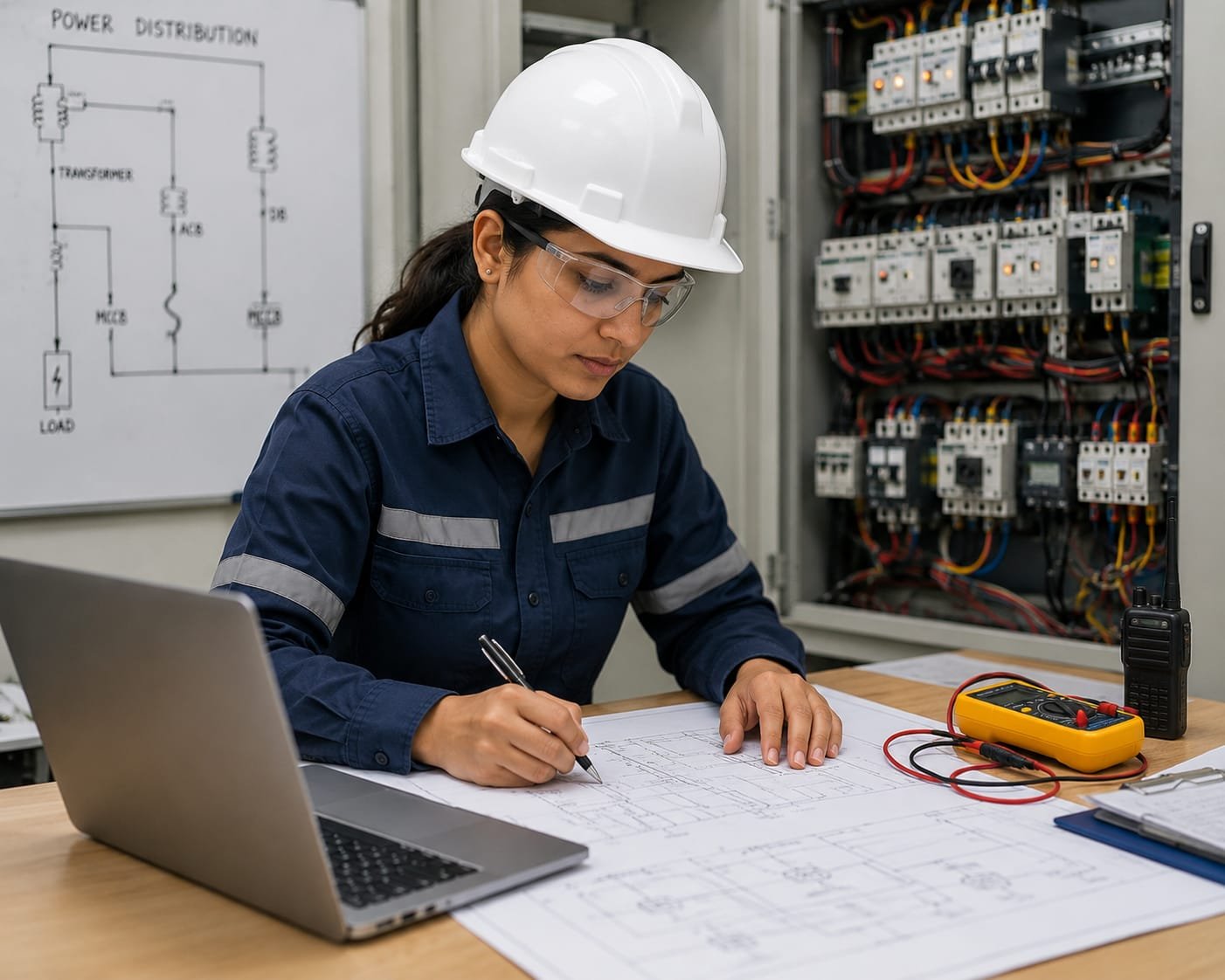
You check electrical equipment such as transformers, cables, and control panels.
STEP 5
You inspect the electrical system and look for any problems.
STEP 6
If there is a power failure, you help find the cause and restore the electricity.
STEP 7
You make sure all electrical equipment is working safely.
STEP 8
If you enjoy Physics, electricity, and solving problems, this career may be right for you.
Where do Electrical Engineers work? (Job Roles + Growth)
Electrical Engineers work in : Power generation plants, Electricity transmission and distribution companies, Electrical equipment companies, Construction companies, Renewable energy companies, Manufacturing plants, Railway projects, and Electrical engineering consultancy firms.
🟢 Beginner Roles
Junior Electrical Technician
(After Diploma)
Maintains electrical equipment and wiring systems.
Graduate Engineer Trainee (GET)
(After B.Tech)
Assists engineers in testing electrical systems.
🔵 Mid-Level Roles
Electrical Design Engineer
(After B.Tech + Experience)
Designs electrical systems and power networks.
Power System Engineer
(After B.Tech Specialization + Experience)
Monitors power grids and electrical substations.
🟣 Advanced Roles
Electrical Project Manager
(After M.Tech / Advanced Specialization)
Manages electrical projects and safety standards.
Chief Electrical Engineer
(After Executive Program + Experience)
Leads large electrical infrastructure projects.
Power Generation Companies
Generate electricity for cities and industries.
Power Distribution Companies
Deliver electricity to homes and businesses.
Manufacturing Industries
Maintain machines and electrical systems.
Railways & Metro Systems
Support trains and metro electrical networks.
Renewable Energy Companies
Work with solar and wind power systems.
Global Engineering Companies
Work on electrical projects around the world.
(Click Yes or No for each question)
1. Have you ever wondered how electricity reaches your home?
2. Do you know who designs the electrical systems inside a building?
3. Are you interested in learning how electrical systems work?
4. Imagine you are working as an Electrical Engineer for a company that builds large buildings. The company is building a new shopping mall. Your job is to plan where electrical wires, lights, and power connections should be placed so that electricity can safely reach different parts of the building. Would you enjoy doing this kind of work?
5. Imagine a new apartment building is being constructed in your hometown. Your job is to check the electrical system and make sure the lights, fans and other electrical equipment work safely. Are you interested in doing this?