- Have you ever wondered how your phone can send messages or make video calls?
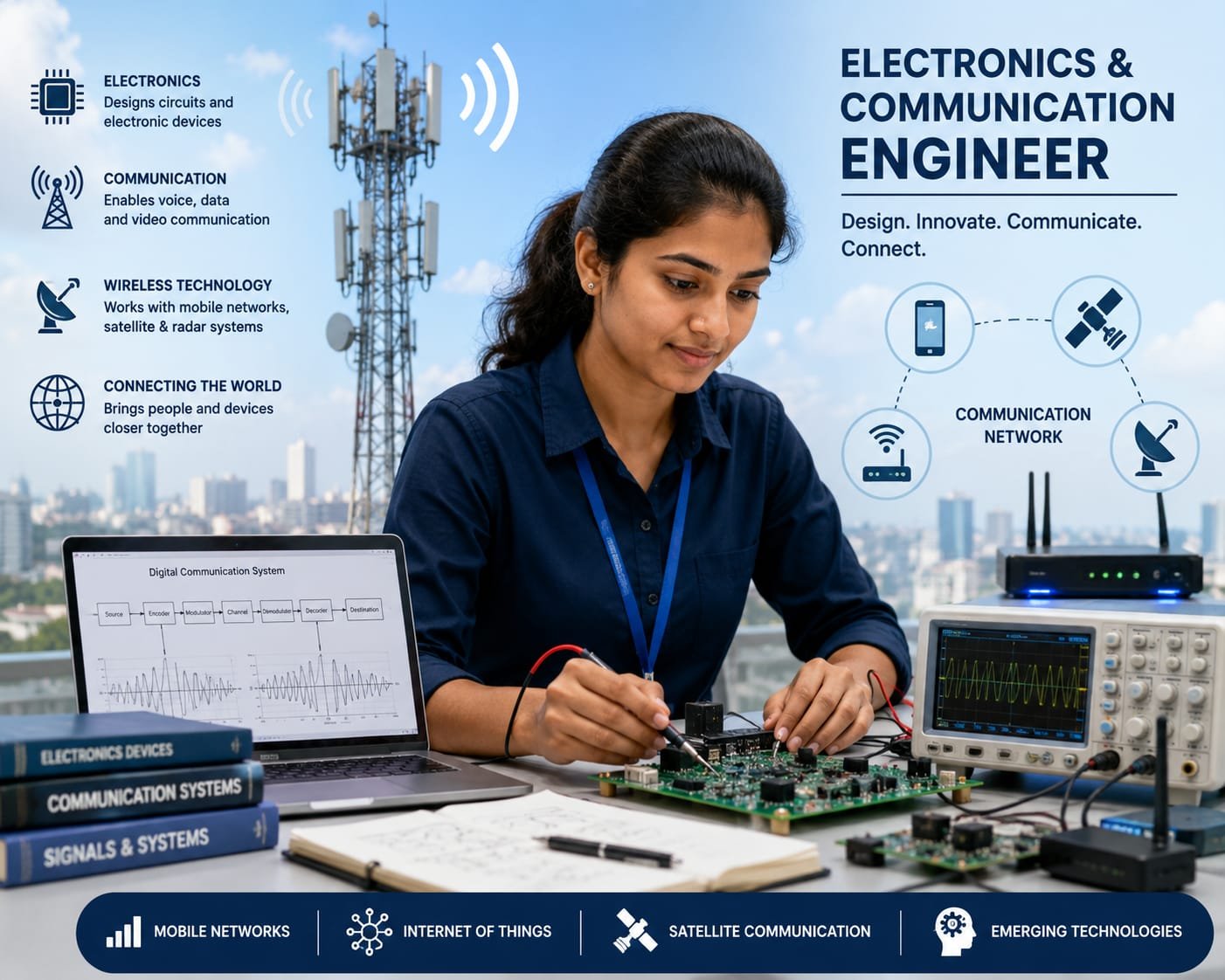
- When you make a video call, the data from your phone first reaches a nearby communication tower or Wi-Fi router.
- The data is then sent through communication networks to the other person's phone.
- Mobile phones, Wi-Fi routers, communication towers, and satellites work together to make this possible.
- The person who designs and maintains these systems is called an Electronics and Communication Engineer.
- 👉 In simple words: Electronics and Communication Engineers design electronic devices and communication systems that help people stay connected.
Electronics and Communication Engineer
What Do They Do?
🎓 How to Become an Electronics and Communication Engineer
You have two options:
-
Start early with a Diploma
After Class 10, you can choose a relevant diploma course. Complete the diploma and join the second year of an engineering course by applying through lateral entry. -
Finish Class 12
Complete Class 11 and 12, then you can do a B.Tech./B.E. in the relevant field.
These diploma courses help students learn electronics, communication systems, circuits, networking, and embedded devices.
Diploma in Electronics and Communication Engineering
Duration: 3 Years
Eligibility: 10th Pass with Science and Mathematics
Entrance Exam: State Polytechnic Entrance Exams (e.g., JEECUP, POLYCET)
Note: Students can work as electronics technicians or continue higher studies in Electronics and Communication Engineering.
B.Tech / B.E. in Electronics and Communication Engineering (ECE)
Duration: 4 Years
Eligibility: 10+2 with Physics, Chemistry, and Mathematics (PCM)
Entrance Exam: JEE Main / JEE Advanced / State Entrance Exams / University Entrance Exam (VITEEE)
📝 Exam Details
(Click on an exam name to see full details)
JEE Main JEE Advanced State Engineering Entrance Exams University Entrance ExamsB.Tech Lateral Entry in Electronics and Communication Engineering
Duration: 3 Years (Direct admission into 2nd year)
Eligibility: 3-Year Diploma in ECE or allied branches
Entrance Exam: State Lateral Entry Entrance Exams (e.g., JELET, TS ECET)
Note:
(Age limits, marks, and admission process may vary depending on the college or state. These courses are available in many colleges and universities across India. You can choose colleges based on your location, budget, and entrance exams.)
🏛️ Top Colleges for Electronics and Communication Engineering
(Tap on a college to view the details)
After Class 10
Government Polytechnic, Pune, Maharashtra Government Polytechnic College, Kalamassery PSG Polytechnic College, CoimbatoreAfter Class 12
Indian Institute of Technology (IIT) Roorkee, Roorkee Indian Institute of Technology (IIT) Dharwad, Karnataka National Institute of Technology (NIT) Trichy, Tiruchirappalli Manipal Institute of Technology (MIT), Manipal, KarnatakaAfter Diploma (Lateral Entry)
Cochin University of Science and Technology (CUSAT), Kochi, Kerala COEP Technological University, Pune Manipal Institute of Technology (MIT), Manipal, KarnatakaAfter Graduation (Master's Degrees & Deep R&D)
Indian Institute of Science (IISc), Bangalore Indian Institute of Technology (IIT) Dharwad, Karnataka Manipal Institute of Technology (MIT), Manipal, Karnataka Indraprastha Institute of Information Technology (IIT-Delhi), New Delhi SRM Institute of Science and Technology, Tamil NaduSTEP 1
Imagine you are working as an Electronics and Communication Engineer.
STEP 2
Millions of people use mobile phones to make calls, send messages, and access the internet.
STEP 3
Your job is to help keep these communication systems working properly.
STEP 4
You check the equipment that helps mobile phones connect to the network.
STEP 5
You find and fix problems in communication systems.
STEP 6
You test new technologies that improve communication.
STEP 7
You help people make calls, send messages, and use the internet without problems.
STEP 8
If you enjoy electronics, communication technology, and solving problems, this career may be right for you.
Where do Electronics and Communication Engineers work? (Job Roles + Growth)
Electronics and Communication Engineers work in : Electronics companies, Telecommunications companies, Semiconductor companies, Consumer electronics companies, Networking companies, Aerospace and defense companies, Broadcasting companies, and Research laboratories.
🟢 Beginner Roles
Junior Electronics Technician
(After Diploma)
Repairs electronic circuits and devices.
Graduate Engineer Trainee (GET)
(After B.Tech)
Assists engineers in testing electronic systems.
🔵 Mid-Level Roles
Embedded Systems Engineer
(After B.Tech + Experience)
Develops electronics for smart devices.
VLSI Design Engineer
(After B.Tech Specialization + Experience)
Designs microchips used in electronic devices.
🟣 Advanced Roles
Telecom Network Manager
(After M.Tech / Advanced Specialization)
Manages communication networks and towers.
Chief Hardware Architect
(After Executive Program + Experience)
Leads the development of electronic products.
Mobile Network Companies
Build and manage mobile communication networks.
Telecommunication Companies
Develop communication systems and network services.
Electronics Manufacturing Companies
Design and manufacture electronic devices.
Satellite & Space Industries
Develop satellite communication technologies.
Automotive Electronics Industries
Create electronics used in modern vehicles.
Global Technology Companies
Work on advanced communication technologies worldwide.
(Click Yes or No for each question)
1. Have you ever used the internet on your mobile phone?
2. Have you ever wondered how your phone connects to the internet?
3. Are you interested in learning how mobile phones and the internet work?
4. Imagine you are working as an Electronics and Communication Engineer for a mobile network company. The company wants to improve its mobile network. So people can get a strong signal and make calls without interruptions. Your job is to work on the electronic and communication systems that help send signals between mobile phones and network towers. Would you enjoy doing this kind of work?
5.Imagine a house owner wants to make their home smart. They want to control the lights, fans, and other electronic devices using their mobile phone. They approach you to set up this system. You connect the devices to a smart control system. This allows to communicate with the mobile phone through Wi-Fi or Bluetooth. Would you enjoy doing this kind of work?