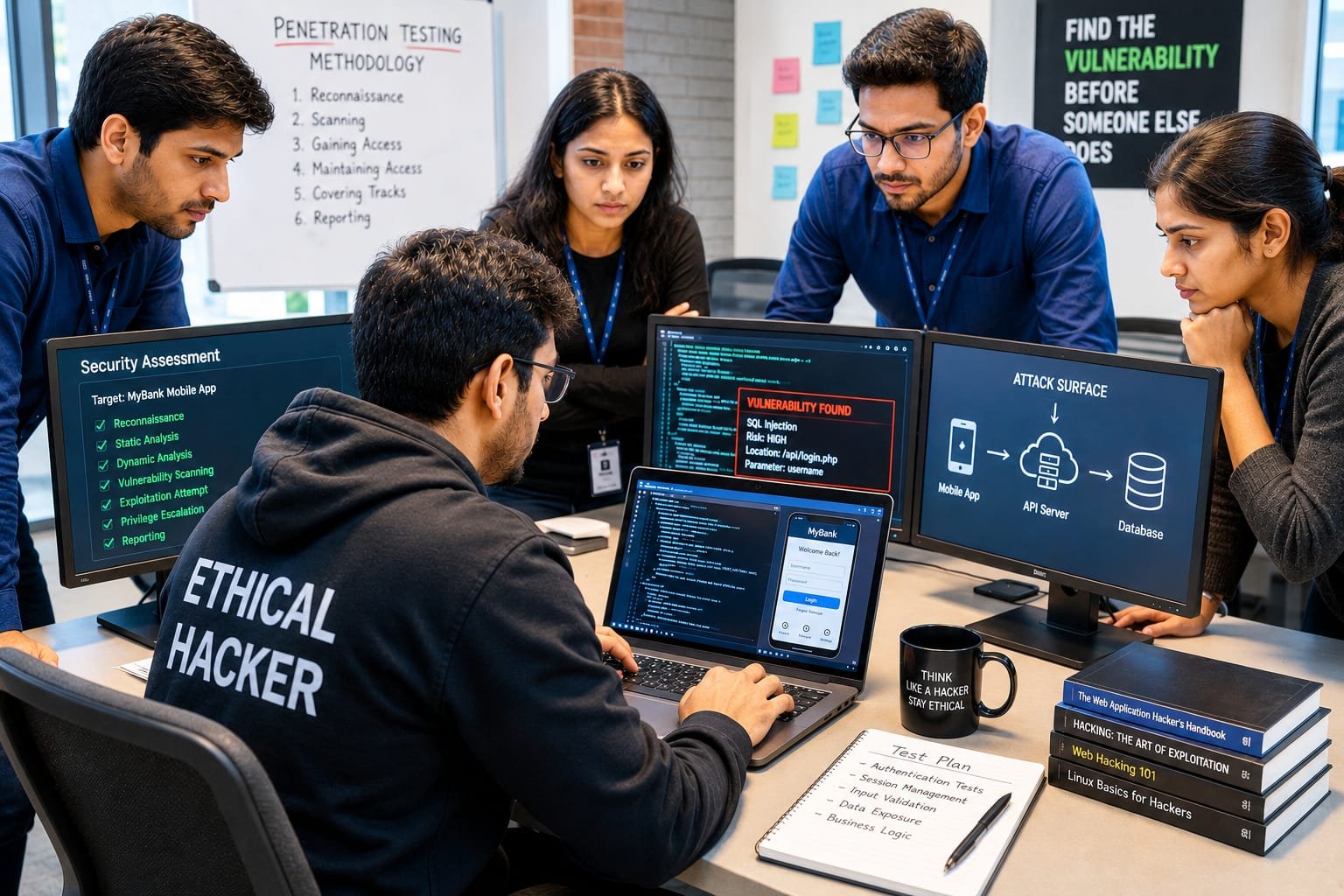
- Imagine a bank has built a new mobile app for its customers.
- Before launching it, the bank must make sure the app is safe to use.
- They need to make sure that hackers cannot steal customers personal information.
- The person who finds these security weaknesses and helps the company fix them is called an Ethical Hacker.
- 👉 In simple words: Ethical Hackers legally test computer systems, websites, and apps to find security problems.
Ethical Hacker
What Do They Do?
🎓 How to Become an Ethical Hacker
These beginner-level courses help students learn computer systems, networking, cyber security basics, ethical hacking concepts, and digital safety skills.
Diploma in Computer Science and Engineering with Cyber Security
Duration: 1–3 Years
Eligibility: Class 10 Pass
Entrance Exam: Polytechnic Entrance Exam / Merit-Based Admission
Diploma in Information Technology & Cyber Security
Duration: 3 Years
Eligibility: Class 10 Pass
Entrance Exam: Polytechnic Entrance Exam / Merit-Based Admission
Diploma in Computer Science Engineering
Duration: 3 Years
Eligibility: Class 10 Pass
Entrance Exam: Polytechnic Entrance Exam / Merit-Based Admission
📝 Exam Details
(Click on the exam name to see full details)
Polytechnic Entrance Exam Merit-Based AdmissionNote: Many Ethical Hackers build their skills by learning networking, operating systems, cyber security tools, penetration testing techniques, and practicing how to find security weaknesses before criminals do.
These degree programs help students learn cyber security, ethical hacking, penetration testing, network defense, and digital investigation techniques.
B.Tech in Computer Science Engineering (Cyber Security)
Duration: 4 Years
Eligibility: 10+2 Pass (with Physics, Chemistry, and Mathematics)
Entrance Exam: JEE Main / State Engineering Entrance Exams
B.Tech Information Technology
Duration: 4 Years
Eligibility: 10+2 Pass (Physics, Chemistry, and Mathematics)
Entrance Exam: JEE Main / State Engineering Entrance Exams
Bachelor of Computer Applications (BCA) in Ethical Hacking
Duration: 3 - 4 Years (varies by university)
Eligibility: 10+2 Pass (Any Stream; Computer Science Preferred)
Entrance Exam: CUET-UG / University Merit-Based Admission
B.Sc in Cyber Security & Ethical Hacking
Duration: 3 Years
Eligibility: 10+2 Pass (Science Stream Preferred)
Entrance Exam: CUET-UG / University Entrance Test
📝 Exam Details
(Click on the exam name to see full details)
JEE Main CUET-UG State Engineering Entrance Exams University Entrance ExamsNote: Most Ethical Hackers build strong skills in programming, networking, operating systems, penetration testing, and cyber security tools during their degree programs.
Students with a diploma can enter the second year of selected degree programs through lateral entry and continue building advanced cyber security skills.
B.Tech Lateral Entry (Cyber Security / Information Security)
Duration: 3 Years
Eligibility: Diploma in Computer Science, Information Technology, or Cyber Security
Entrance Exam: State Lateral Entry Entrance Exams
B.Tech Lateral Entry in Computer Science Engineering
Duration: 3 Years
Eligibility: Diploma in Computer Science or Information Technology
Entrance Exam: State Lateral Entry Entrance Exams
B.Tech Lateral Entry in Information Technology
Duration: 3 Years
Eligibility: Diploma in Computer Science or Information Technology
Entrance Exam: State Lateral Entry Entrance Exams
BCA (Lateral Entry) with Cyber Security Specialization
Duration: 2–3 Years
Eligibility: Relevant Diploma in Computing or IT
Entrance Exam: University Entrance Test / Merit-Based Admission
📝 Exam Details
(Click on the exam name to see full details)
State Lateral Entry Exams Merit-Based AdmissionNote: Diploma students can directly enter the second year of eligible degree programs and continue specializing in cyber security, ethical hacking, network defense, and penetration testing.
Advanced courses help graduates specialize in penetration testing, cyber defense, vulnerability assessment, and advanced security research.
M.Tech in Cyber Security and ethical hacking
Duration: 2 Years
Eligibility: B.Tech/B.E. (CSE, IT) or MCA with valid GATE Score
Entrance Exam: GATE / University Entrance Exams
M.Sc in Cyber Security & Ethical Hacking
Duration: 2 Years
Eligibility: Graduate in Computer Science, IT, BCA, or Related Fields
Entrance Exam: CUET-PG / University Entrance Exams
MCA in Cyber Security
Duration: 2 Years
Eligibility: Graduate in Computer Science, IT, BCA, or Related Fields
Entrance Exam: CUET-PG / University Entrance Exams
Post Graduate Diploma in Cybersecurity
Duration: 1 Year
Eligibility: Graduate (Any Technical or Computing Background)
Entrance Exam: Direct Admission / Interview
📝 Exam Details
(Click on the exam name to see full details)
GATE CUET-PG University Entrance Exam Direct Admission InterviewNote: Many Ethical Hackers also earn professional certifications such as CEH, OSCP, CompTIA Security+, and eJPT to strengthen their practical hacking and security testing skills.
Note:
(Age limits, marks, and admission process may vary depending on the college or state.
Below are some colleges that offer these courses.
These courses are available in many colleges and universities across India. You can choose colleges based on your location, budget, and entrance exams.)
🏛️ Colleges offering these courses in India
(Tap on a college to view the details)
After Class 10
Silver Oak University, Ahmedabad, Gujarat Government Polytechnic College, Kalamassery, Kerala PSG Polytechnic College, Coimbatore, Tamil NaduAfter Class 12
SRM Institute of Science & Technology, Tamil Nadu REVA University, Bengaluru Yenapoya Institute of Arts, Science, Commerce and Management, Mangaluru, Karnataka Lovely Professional University, Punjab S-VYASA Global City Campus, Bengaluru Yenapoya UniversityAfter Diploma (Lateral Entry)
Chandigarh University, Uttar Pradesh Lovely Professional University, Punjab CT University, Punjab CUSAT, kochi, KeralaAfter Graduation (Master's Degrees & Advanced Hacking Research)
SRM University, Andra Pradesh Yenapoya University, Manglore, Karnataka Lovely Professional University -online Rajagiri College of Social Sciences, Kochi, KeralaCertification Institutes
Indian School of Ethical Hacking (ISOEH), Kolkata EC-Council Hacker School IBM via CourseraSTEP 1
Imagine you are an Ethical Hacker.
STEP 2
A bank asks you to test whether their app is safe from hackers.
STEP 3
You legally try to break into the system they have used to build the app.
STEP 4
You look for any weakness in the system that hackers could use to steal information.
STEP 5
You create a report explaining the problems and how they can be fixed.
STEP 6
The company fixes the weaknesses, making the app safer for millions of users.
STEP 7
If you enjoy solving puzzles, and finding hidden weaknesses, this career may suit you.
Where do Ethical Hackers work? (Job Roles + Growth)
Ethical Hackers work in : Cybersecurity firms, IT and technology companies, Banks and financial institutions, Government organisations, Consulting firms, e-commerce companies, and Telecommunications companies.
🟢 Beginner Roles
Junior Penetration Tester
(After Short-Term Certification / Diploma)
Tests websites and systems for basic security weaknesses.
Vulnerability Assessment Associate
(After Diploma / BCA / B.Tech)
Finds security gaps and reports them to security teams.
Security Testing Assistant
(After Cyber Security Training)
Helps test applications, websites, and computer networks.
Cyber Security Auditor
(After Diploma / Graduation)
Checks whether companies follow important security rules.
🔵 Mid-Level Roles
Ethical Hacker / Penetration Tester
(After BCA / B.Tech + Certification)
Legally tries to break into systems and finds security weaknesses.
Web Application Security Tester
(After Security Testing Experience)
Tests websites and apps to find vulnerabilities before hackers do.
Mobile Security Analyst
(After Mobile Security Training)
Tests mobile apps and devices for security problems.
Application Security Engineer
(After BCA / B.Tech + Experience)
Helps developers build secure software and fix security issues.
🟣 Advanced Roles
Lead Penetration Tester / Red Team Leader
(After MCA / M.Tech + Experience)
Leads teams that simulate cyber attacks to test company security.
Security Consultant
(After Advanced Security Experience)
Advises organizations on improving their cyber security defenses.
Principal Security Consultant
(After Senior Leadership Experience)
Designs security strategies and guides large organizations.
Cybersecurity Companies
Test systems and help organizations find security weaknesses.
Banking & Financial Companies
Protect online banking systems and customer financial information.
Cloud Technology Companies
Test cloud platforms and improve security before attackers find weaknesses.
Software & App Development Companies
Find security flaws in websites, mobile apps, and software products.
Cybersecurity Consulting Firms
Perform security audits and penetration testing for different clients.
Remote Ethical Hacking Jobs
Test systems and applications for organizations around the world.
(Click Yes or No for each question)
1. Have you ever heard about hacking?
2. Have you ever thought about how hackers break into a website or app?
3. Are you interested in learning how to find security weaknesses in websites, apps, and computer systems?
4. Imagine you are working as an Ethical Hacker for a company. The company wants to make sure its website is safe. You test the website like how a hacker do and look for security weaknesses. You find a weakness and tell the company how it can be fixed. Do you like this type of work?
5. A company has created a new mobile app and wants to make sure it is safe before people start using it. You test the app and check if there are any security threats. If you find a security problem, you inform the company so they can fix it. Would you enjoy doing this kind of work?