- IoT (Internet of Things) is the technology that connects everyday devices to the internet so they can share information.
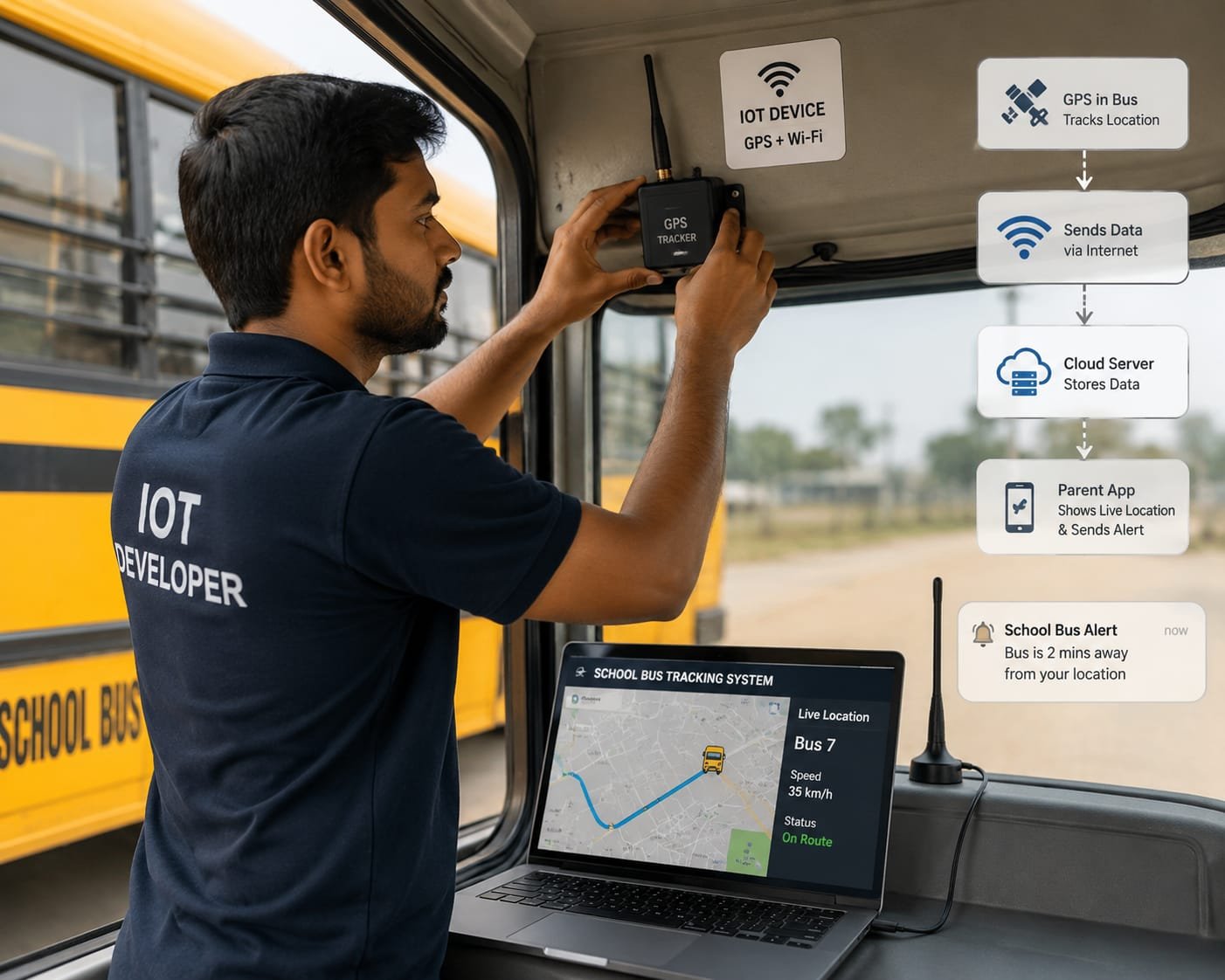
- Think about a school bus
- Students usually wait outside their house for the school bus.
- Imagine if parents could see where the school bus is on their mobile phone.
- When the bus is near their home, they get a notification.
- This helps parents know the right time to take their child outside for the bus.
- This is possible because the bus and the parent's phone can share information through internet.
- The person who creates this technology is an IoT Developer.
- 👉 In simple words: IoT Developers create systems that connect devices to the internet so they can share information.
IoT (Internet of Things) Developer
What Do They Do?
🎓 Courses to Become an IoT Developer
After completing 10th, you can start with a diploma in electronics or computer-related fields to enter the IoT domain early.
Diploma in Electronics and Communication Engineering
Duration: 3 Years
Eligibility: Class 10 with Science and Mathematics
Entrance Exam: State Polytechnic Entrance Exams (e.g., JEECUP, AP POLYCET)
Diploma in Computer Science Engineering
Duration: 3 Years
Eligibility: Class 10 pass
Entrance Exam: State-level entrance exams (e.g., MSBTE, Delhi CET)
Diploma in Electrical & Electronics Engineering
Duration: 3 Years
Eligibility: Class 10 pass
Entrance Exam: State-level entrance exams (e.g., MSBTE, Delhi CET)
Diploma in Computer Engineering & IOT
Duration: 3 Years
Eligibility: Class 10 pass
Entrance Exam: State-level entrance exams (e.g., MSBTE, Delhi CET)
📝 Exam Details
(Click on the exam name to see full details)
State Polytechnic Entrance ExamsNote: Admission may be based on entrance exams or 10th marks depending on the state or institution.
After completing 12th with PCM, you can pursue a degree in Computer Science or Electronics to enter the IoT field.
B.Tech in Computer Science Engineering (Specialization in IoT)
Duration: 4 Years
Eligibility: 10+2 with Physics, Chemistry, and Mathematics (PCM)
Entrance Exam: JEE Main, VITEEE, SRMJEEE, KIITEE
B.Tech in Electronics and Communication Engineering
Duration: 4 Years
Eligibility: 10+2 with PCM subjects
Entrance Exam: JEE Main, JEE Advanced, MHT CET, KCET
BCA (Bachelor of Computer Applications)
Duration: 3 Years
Eligibility: 10+2 (any stream, depending on university)
Entrance Exam: University-specific entrance exams (if applicable)
B.Sc. in Computer Science
Duration: 3 Years
Eligibility: 10+2 with Mathematics/Computer Science, depending on university
Entrance Exam: University-specific entrance exams (if applicable)
📝 Exam Details
(Click on the exam name to see full details)
JEE Main JEE Advanced State Entrance Exams University Entrance ExamsNote: Admission to top colleges is mainly through entrance exams, while some private colleges offer merit-based admission.
Important Note: Computer Science helps with software and app development, while Electronics focuses on hardware and sensors—both are important for IoT careers.
After completing a diploma, you can directly enter the 2nd year of B.Tech through lateral entry and continue your journey in IoT.
B.Tech in Computer Science Engineering (IoT Specialization) (Lateral Entry)
Duration: 3 Years (starts from 2nd year)
Eligibility: 3-year Diploma in Computer Science or IT
Entrance Exam: State Lateral Entry Tests (JELET, ECET, LEET)
B.Tech in Electronics and Communication Engineering (Lateral Entry)
Duration: 3 Years (starts from 2nd year)
Eligibility: 3-year Diploma in ECE or Electrical Engineering
Entrance Exam: State Lateral Entry Tests (JELET, ECET)
📝 Exam Details
(Click on the exam name to see full details)
State Lateral Entry Entrance ExamsNote: Lateral entry allows diploma students to directly join the 2nd year of engineering programs.
Important Note: Choose Computer Science if you like coding and software, or Electronics if you enjoy working with circuits and hardware—both are important in IoT.
After completing your degree, you can specialize in IoT through higher studies or professional courses to advance your career.
M.Tech in Internet of Things
Duration: 2 Years
Eligibility: B.E./B.Tech in CSE, IT, ECE, or EEE
Entrance Exam: GATE (CS or EC paper)
M.Tech in Embedded Systems
Duration: 2 Years
Eligibility: B.E./B.Tech in ECE, EEE, CSE, IT, or related engineering field
Entrance Exam: GATE (depending on the institute)
M.Tech in CSE (IoT)
Duration: 2 Years
Eligibility: B.E./B.Tech in CSE, IT, ECE, EEE, or related engineering field
Entrance Exam: GATE (depending on the institute)
MCA in Internet of Things (IoT)
Duration: 2 Years
Eligibility: Bachelor's degree in Computer Science, Computer Applications, Information Technology, or a related field
Entrance Exam: University or state-level entrance exam (depending on the institute)
PG Diploma in Internet of Things (Professional Course)
Duration: 6 Months to 1 Year
Eligibility: B.E./B.Tech in any technical field
Entrance Exam: C-CAT (for CDAC) or institutional interviews
📝 Exam Details
(Click on the exam name to see full details)
GATE C-CAT (CDAC)Note: GATE is required for top M.Tech colleges, while PG diploma courses may require entrance tests or interviews.
Important Note: M.Tech is best for deep technical knowledge and research, while PG Diploma courses are faster and more industry-focused for job readiness.
Note:
(Age limits, marks, and admission process may vary depending on the college or state.
Below are some colleges that offer these courses.
These courses are available in many colleges and universities across India. You can choose colleges based on your location, budget, and entrance exams.)
🏛️ Colleges offering these courses in India
(Tap on a college to visit the official website)
After 10th Pass (Diplomas)
Government Polytechnic, Pune Lovely Professional University, Punjab Government Polytechnic College, Kalamassery, Kerala Government Polytechnic, Mydukur, Andra PradeshSTEP 1
Imagine you are working as an IoT Developer.
STEP 2
Your company wants to build a smart home security system.
STEP 3
You connect smart cameras and sensors to the internet.
STEP 4
You write software that collects information from these devices.
STEP 5
You connect the system to a mobile app.
STEP 6
If someone enters the house, the app sends an alert to the owner.
STEP 7
If you enjoy smart devices, coding, and solving real-world problems, this career may be right for you.
Where do IoT Developers work? (Job Roles + Growth)
IoT Developers work in : IoT companies, Electronics companies, Smart home companies, Industrial automation companies, Automotive companies, Healthcare technology companies, Telecommunications companies, and Smart city projects.
🔵 Beginner Roles
Junior Firmware Tester
(After Short-Term Certification / Diploma)
They run tests to check whether device software works correctly.
IoT Associate Developer
(After Diploma / B.Tech)
They write basic code to collect data from sensors.
🔵 Mid-Level Roles
IoT Embedded Engineer
(After B.Tech + Experience)
They program microchips and connect devices to wireless networks.
IoT Cloud Developer
(After B.Tech + Experience)
They build cloud systems that store and process device data.
🟣 Advanced Roles
IoT Solutions Architect
(After M.Tech / Advanced Specialization)
They design large networks connecting thousands of smart devices.
VP of IoT Systems
(After Advanced Executive Program + Experience)
They lead teams that build large-scale smart infrastructure projects.
IoT & Smart Device Companies
Build connected devices and sensor systems.
Smart Home Technology Companies
Create automated home devices and appliances.
Industrial Automation Companies
Develop smart factory and monitoring systems.
Automotive Technology Companies
Build connected and intelligent vehicle systems.
Cloud & Technology Companies
Manage platforms that process device data.
Smart City Projects
Develop intelligent infrastructure and services.
(Click Yes or No for each question)
1. Have you ever used a smartwatch or fitness band to track your steps, heart rate, or sleep?
2. Have you ever wondered how a smartwatch knows how many steps you have walked?
3. Do you like to know how smart devices work?
4. Imagine you are working as an IoT Developer in a company that makes smart lights. The company wants people to control the lights using their mobile phones. Your job is to create the software that connects the smart lights to a mobile app. The app allows people to turn the lights on and off using their phones. Are you interested in doing this kind of work?
5. A company wants to make a smart watch that can count your steps and check your heart rate. The watch collects this information and sends it to your mobile phone. Your job is to create the system that helps the watch send this information to the phone. Would you like to do this kind of work?