- A boy falls from his bicycle. He has pain in his arm, so his parents take him to the hospital.
- The doctor checks him and wants to know whether his arm is broken. So, the doctor sends him for an X-ray.
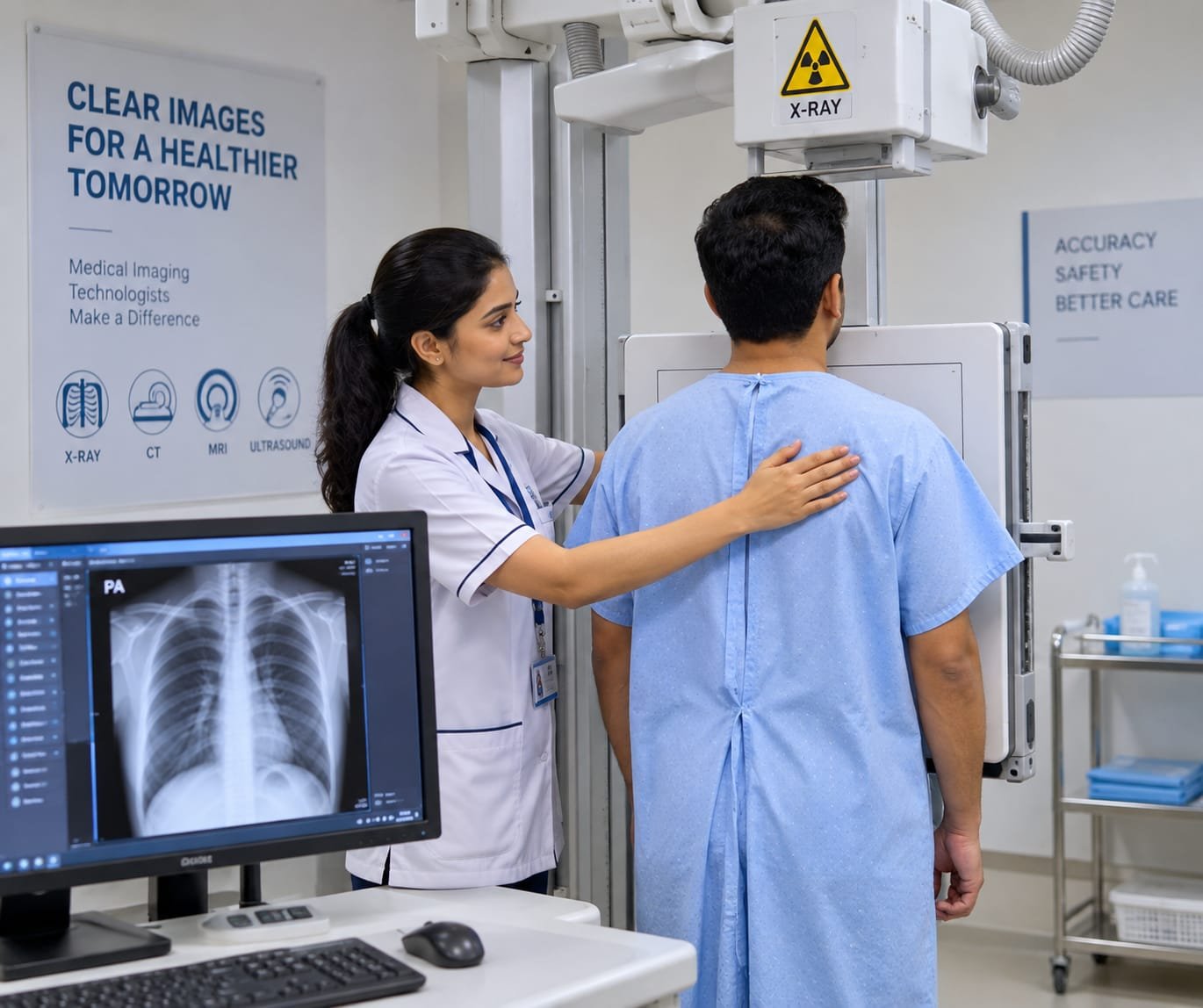
- In the X-ray room, there is a person who positions him correctly and takes an X-ray of his arm.
- They also check whether the X-ray image is clear and properly captured.
- The person who does this work is called a Medical Imaging Technologist.
- 👉 In simple words: Medical Imaging Technologists are healthcare professionals who operate medical imaging equipment such as X-ray, CT scan, and MRI
Medical Imaging Technologist
What Do They Do?
🎓 How to Become a Medical Imaging Technologist
The courses to pursue this career are given below :
After completing 12th, you can pursue diploma or degree courses in medical imaging technology to learn how to operate imaging equipment and create images of the inside of the body.
Diploma in Medical Radiology and Imaging Technology (DMRIT)
Duration: 2.5 Years (including clinical training/internship)
Eligibility: 10+2 with Science subjects
Entrance Exam: State Paramedical Entrance Exam / Institute-Specific Entrance Test / Merit-Based Admission
Bachelor of Medical Radiology and Imaging Technology (BMRIT)
Duration: 3–4 Years (including internship)
Eligibility: 10+2 with Physics, Chemistry and Biology
Entrance Exam: AIIMS B.Sc. Allied & Health Care Entrance Examination / CUET-UG / State Paramedical Entrance Exam / Institute-Specific Entrance Test / Merit-Based Admission
B.Sc. in Medical Imaging Technology (B.Sc. MIT)
Duration: 3–4 Years (including internship)
Eligibility: 10+2 with Physics, Chemistry and Biology
Entrance Exam: CUET-UG / State Paramedical Entrance Exam / Institute-Specific Entrance Test / Merit-Based Admission
B.Sc. in Radiography and Medical Imaging Technology
Duration: 3–4 Years (including internship)
Eligibility: 10+2 with Physics, Chemistry and Biology
Entrance Exam: CUET-UG / State Paramedical Entrance Exam / Institute-Specific Entrance Test / Merit-Based Admission
📝 Exam Details
(Click on the exam name to see full details)
AIIMS B.Sc. Allied & Health Care Entrance Exam State Paramedical Exam Institute Specific Test CUET Merit Based AdmissionNote: Top colleges require entrance exams, while some colleges offer admission based on merit or institute-level tests.
After graduation, you can pursue advanced courses in medical imaging technology to develop knowlegde and skills in areas such as radiography, CT, MRI, and other diagnostic imaging techniques.
M.Sc. Medical Imaging Technology / M.Sc. Radiography & Medical Imaging Technology
Duration: 2 Years
Eligibility: Relevant bachelor's degree such as BMRIT, B.Sc. Medical Imaging Technology, or B.Sc. Radiography, as specified by the university
Entrance Exam: CUET-PG / University-Specific Entrance Exam / Merit-Based Admission
Master of Medical Radiology and Imaging Technology (M.MRIT)
Duration: 2 Years
Eligibility: B.MRIT / B.Sc. Radiography / B.Sc. Medical Radiology & Imaging Technology or equivalent degree, as specified by the university
Entrance Exam: CUET-PG / University-Specific Entrance Exam / Merit-Based Admission
📝 Exam Details
(Click on the exam name to see full details)
CUET-PG University Entrance Exams Merit Based AdmissionNote: Advanced courses focus on specialization.
Note:
(Age limits, marks, and admission process may vary depending on the college or state.
Below are some colleges that offer these courses.
These courses are available in many colleges and universities across India. You can choose colleges based on your location, budget, and entrance exams.)
Colleges offering these courses in India
(Tap on a college to view the details)
After Class 12
TISS School of Skill Education, Mumbai, Maharashtra Manipal College of Health Professions (MCHP), Manipal, Karnataka All India Institute of Medical Sciences (AIIMS), New Delhi Little Flower Institute of Allied Health Sciences, Bengaluru, Karnataka M.V.Shetty Institute of Allied Health Sciences, Mangaluru, Karnataka Sumandeep Vidyapeeth, Vadodara, Gujarat Sri Guru Ram Das University of Health Sciences, Amritsar, Punjab CGC University, Mohali, Punjab Manipal College of Health Professions (MCHP), Manipal, KarnatakaAfter Graduation
M.S.Ramaiah University of Applied Sciences (RUAS), Bengaluru, Karnataka SRM Institute of Science and Technology (SRMIST), Kattankulathur, Tamil Nadu Symbiosis Institute of Health Sciences (SIHS), Pune, Maharashtra Sri Ramachandra Institute of Higher Educatikn and Research (SRIHER), Chennai, Tamil NaduSTEP 1
Imagine you are working as a Medical Imaging Technologist in a hospital.
STEP 2
A patient comes for an X-ray, CT scan, or MRI.
STEP 3
You check the patient's details and prepare them for the scan.
STEP 4
You place the patient in the correct position.
STEP 5
You operate the imaging equipment and take the images.
STEP 6
You check whether the images are clear.
STEP 7
You send the images to the radiologist or doctor for examination.
STEP 8
If you like healthcare, technology, and working with people, this career may suit you.
Hospitals
Work in hospitals and take X-rays, CT scans, MRI scans, and other medical images.
Diagnostic Centres
For taking X-rays, CT scans, MRI scans, and other medical images.
Government Health Centres
Take X-rays and other medical images for patients.
Private Healthcare Centres
Take medical images and help doctors examine patients.
Specialised Imaging Centres
Take specialised scans such as CT scans and MRI scans.
Research & Teaching Institutions
Help with medical imaging research, teaching, and training.
Abroad Opportunities
Work in hospitals and diagnostic centres in other countries.
(Click Yes or No for each question)
1. Would you like to work with X-ray equipment and take X-rays of patients?
2. Are you interested in learning how X-ray machines and other medical imaging equipment work?
3. Would you like to work in a hospital or diagnostic centre?
4. Imagine you are working as a Medical Imaging Technologist in a hospital. A doctor sends a patient for an X-ray. You prepare the patient, position them correctly, and take the X-ray. Do you like this kind of work?
5. Imagine you are working in a diagnostic centre. Different patients come for X-rays and other scans. You operate the equipment, take their images, and make sure the images are clear. Would you enjoy doing this kind of work?