- Imagine a live concert with thousands of people watching a singer's performance on stage.
- The music sounds clear and audience enjoys the show.
- someone behind the scene adjusts the microphone, speakers, and sound system so everyone can hear the singer clearly
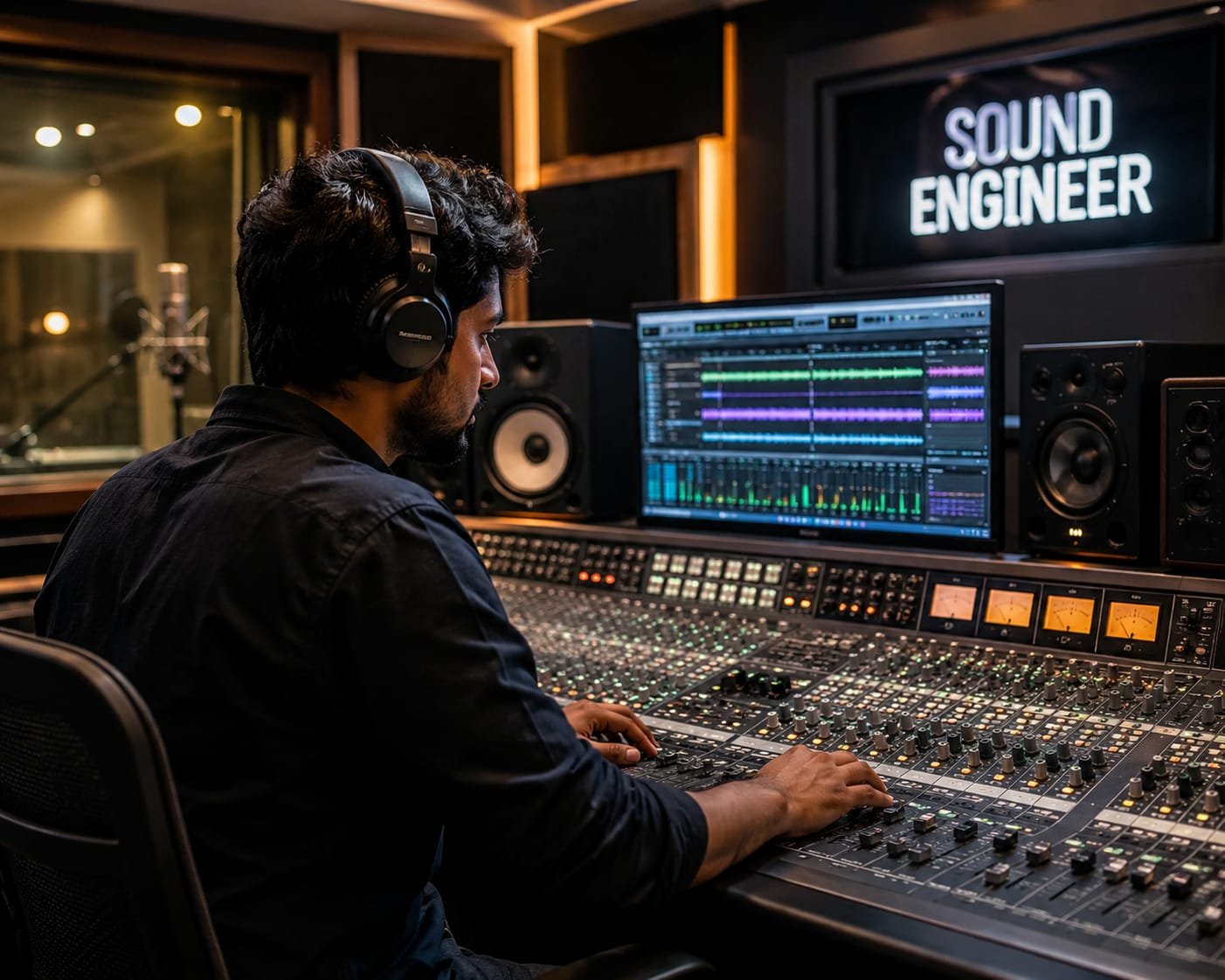
- This professional is called Sound Engineer
- 👉 In simple words: Sound Engineer's job is to make sure people hear clear & good quality sound .
Sound Engineer
What Do They Do?
🎓 How to Become a Sound Engineer
The courses to pursue this career are given below :
These beginner-level courses help students learn sound recording, audio mixing, microphone handling, studio setup, live sound systems, and digital audio editing techniques.
Diploma in Sound Engineering
Duration: 1 - 2 Years
Eligibility: Class 10 Pass
Entrance Exam: Institute aptitude test / Direct Admission
Diploma in Sound Engineering and Sound Recording
Duration: 1 - 2 Years
Eligibility: Class 10 Pass
Entrance Exam: Institute aptitude test / Direct Admission
📝 Exam Details
(Click on the exam name to see full details)
Direct Admission Institute Aptitude TestNote: Most beginner sound engineering courses after 10th focus on practical studio skills, recording techniques, and audio equipment handling rather than national-level entrance exams.
These degree-level courses help students learn advanced audio recording, live sound systems, studio acoustics, sound mixing, audio editing, and professional sound engineering techniques.
BSc in Sound Engineering
Duration: 3 Years
Eligibility: 12th Pass (Preferably with Physics and Mathematics)
Entrance Exam: University Entrance Test
BSc in Sound Design
Duration: 3 Years
Eligibility: 12th Pass
Entrance Exam: University Entrance Test
BVoc (Bachelor of Vocation) in Sound Engineering
Duration: 3 Years
Eligibility: 12th Pass (Any Stream)
Entrance Exam: Merit-Based / University Entrance Exam
Certificate course in Sound Engineering
Duration: 6 - 9 months
Eligibility: 12th Pass (Any Stream)
Entrance Exam: No Exam
Note: Most sound engineering degree programs after 12th focus on studio practice, live audio systems, sound recording, and technical audio production skills along with hands-on projects.
These advanced-level programs help students specialize in studio acoustics, broadcast audio systems, advanced mixing, live sound management, audio post-production, and professional sound engineering technologies.
Master of Design (M.Des) in Sound Design
Duration: 2 Years
Eligibility: Bachelor's Degree
Entrance Exam: University Entrance Exam & Interview
Master of Fine Arts (MFA) in Sound Design
Duration: 2 Years
Eligibility: Bachelor's Degree
Entrance Exam: University Entrance Exam & Interview
PG Diploma in Sound Recording and Television Engineering
Duration: 1 – 3 Years
Eligibility: Graduate (Physics at 10+2 level preferred for top institutes)
Entrance Exam: National Level Entrance Test (FTII JET)
Note: Most postgraduate sound engineering programs focus on advanced studio systems, acoustics, live sound management, film audio production, and real-world recording projects.
These online sound engineering and audio production programs help students learn studio recording, live sound systems, audio mixing, acoustics, digital audio workstations (DAWs), and professional sound editing techniques.
Sound Engineering Courses
Duration: 1 – 6 Months (varies by course)
Eligibility: Open to All
Provider: Coursera
Audio Engineering Courses
Duration: 2 – 20 Hours (varies by course)
Eligibility: Open to All
Provider: Udemy
Sound Engineering and Audio Post-Production
Duration: 5+ Hours
Eligibility: Open to All
Provider: MasterClass Platform
Sound Design Classes
Duration: 30 minutes – few Hours (varies by course)
Eligibility: Open to All
Provider: Skillshare
Audio Engineering
Duration: 3 - 9 Months
Eligibility: Open to All
Provider: KM Music Conservatory, Chennai
Note: Most online sound engineering courses focus on practical studio sessions, audio mixing projects, live sound setup training, and digital audio editing assignments rather than written examinations.
Note:
(Age limits, marks, and admission process may vary depending on the college or state.
Below are some colleges that offer these courses.
These courses are available in many colleges and universities across India. You can choose colleges based on your location, budget, and entrance exams.)
🏛️ Colleges offering these courses in India
(Tap on a college to view details)
After Class 10
Sound Engineering Academy (SEA), Thiruvananthapuram IIFA Multimedia, Bengaluru School of Bollywood Music SRC Community College, TrivandrumAfter Class 12
CMR University, Bengaluru Seamedu, Pune AAFT, Noida Al-Ameen College, Ernakulam Silver Oak University, Ahmedabad IIFA Multimedia, Bengaluru Gulshan Kumar Film &Television Institute of India, Noida DGM College of Media Studies, MumbaiSTEP 1
Imagine you are working as a Sound Engineer in a movie recording studio.
STEP 2
Actors are recording dialogues for an important movie scene.
STEP 3
You use microphones and audio software to make every voice sound clear and natural.
STEP 4
You remove background noise, adjust sound levels, and improve audio quality before the movie is released.
STEP 5
When people watch the movie in theatres, they clearly hear every dialogue and sound effect because of your work.
STEP 6
If this excites you, this career may suit you.
Where do Sound Engineers work? (Job Roles + Growth)
Sound Engineers work in : Music recording studios, Film and television productions, Live concerts and stage shows, Radio stations, Broadcasting studios, Theatre productions, Gaming companies, Podcasts and digital media, and other Audio and entertainment projects.
🟢 Beginner Roles
Studio Assistant Engineer
(After Certificate / Diploma in Sound Recording)
They set up studio microphones, cables, and recording equipment before sessions begin.
Live Sound Assistant
(After Diploma in Sound Engineering / Fundamentals of Live Sound)
They manage stage speakers and sound systems during concerts and live events.
🔵 Mid-Level Roles
Recording Engineer
(After BSc / BVoc in Sound Engineering)
They record vocals, instruments, and audio tracks with professional studio equipment.
Dialogue Editor / Foley Recordist
(After Audio Engineering Foundations / Audio Post-Production)
They edit movie dialogues and create realistic background sound effects for films.
🟣 Advanced Roles
Chief Mix & Mastering Engineer
(After PG Diploma / MSc in Sound Design)
They professionally mix and master songs, albums, and commercial audio projects.
Acoustic Consultant
(After Advanced Acoustics / BTech Route)
They design theatres, studios, and halls so sound travels clearly without echoes.
International Film & OTT Industry
Manage recording,sound mixing, and audio post-production for movies and web series.
Recording Studios & Music Labels
Work with singers and music producers to record, mix and improve audio quality.
Gaming & Digital Media Studios
Create sound effects, background audio for games, animation and digital media.
Live Concerts & International Events
Manage microphones and live audio mixing for concerts and global performances.
(Click Yes or No for each question)
1. Do you like working with sound and audio equipment?
2. Have you ever wondered how dialogues in movies so clear?
3. Are you interested in learning how microphones, speakers, and recording systems work?
4. Imagine you are working as a Sound Engineer in a recording studio. A singer is recording a new song. You set up the microphones and recording equipment. You listen to the singer's voice and make sure the sound is clear. You adjust the sound when needed during the recording. Finally, the singer's voice is recorded clearly. Do you like this type of work?
5. A movie scene background sound is not clear, and the team approaches you for help. You listen to the audio and remove the unwanted sounds. You adjust the sound to make it clear and balanced. Finally, the scene has clear and good-quality sound. Does this type of work interest you?