- Imagine you open an app and login to your account.
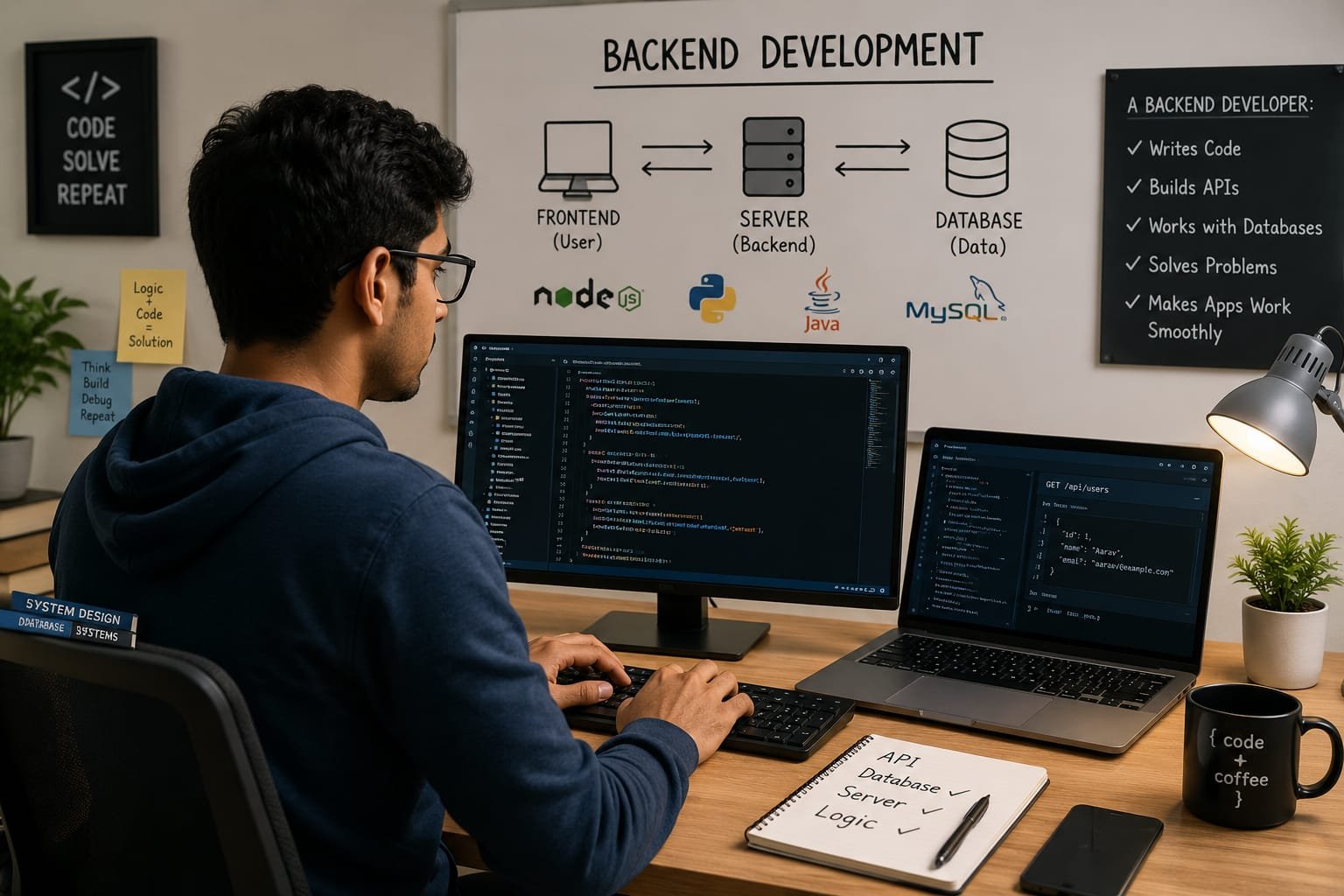
- Your password, and other personal information are stored in the "Backend" of the website or app.
- The person who develop this part is called a Backend Developer.
- 👉 In simple words: Backend Developers build the behind-the-scenes systems that help apps and websites work smoothly.
Backend Developer
What Do They Do?
🎓 How to Become a Backend Developer
These beginner-level computer courses help students learn programming, computer basics, databases, web technologies, and software development skills.
Diploma in Computer Science & Engineering (CSE)
Duration: 3 Years
Eligibility: Class 10 Pass
Entrance Exam: Polytechnic Entrance Exam / Merit-Based Admission
Diploma in Software Development
Duration: 1 – 2 Years
Eligibility: Class 10 Pass
Entrance Exam: Direct Admission / Institute-Level Test
📝 Exam Details
(Click on the exam name to see full details)
Polytechnic Entrance Exam Merit-Based Admission Direct Admission Institute Entrance TestNote: Many backend developers start learning coding through diploma courses, certificates, online programs, and regular programming practice.
These courses help students learn programming, databases, backend technologies, server-side development, and software engineering skills.
Bachelor of Computer Applications (BCA)
Duration: 3 Years
Eligibility: 10+2 Pass (Any Stream; Mathematics or Computer Science preferred)
Entrance Exam: CUET-UG / State-Level CET / University Merit
B.Tech in Computer Science / Information Technology
Duration: 4 Years
Eligibility: 10+2 Pass (with Physics, Chemistry, and Mathematics)
Entrance Exam: JEE Main / State Engineering Entrance Exams
BSc Computer Science
Duration: 3 Years
Eligibility: 10+2 Pass (Mathematics preferred)
Entrance Exam: CUET-UG / Merit-Based Admission
Bachelor in Software Development / Web Technology
Duration: 3 – 4 Years
Eligibility: 10+2 Pass
Entrance Exam: University Entrance Test / Direct Admission
📝 Exam Details
(Click on the exam name to see full details)
CUET-UG JEE Main State Engineering Entrance Exams State Level CET University Entrance Exam Merit-Based Admission Direct AdmissionNote: Backend Developers usually improve their skills through coding practice, projects, internships, and learning modern programming technologies.
Diploma holders can directly enter the 2nd year of degree programs and complete graduation faster.
B.Tech Lateral Entry (CSE / IT)
Duration: 3 Years
Eligibility: Diploma in Computer Science / IT or Related Field
Entrance Exam: State Lateral Entry Entrance Exams
Note: Diploma students can build strong backend development careers through coding practice, internships, projects, and advanced software training.
These advanced courses help students improve backend development, software engineering, cloud computing, database management, and system architecture skills.
Master of Computer Applications (MCA)
Duration: 2 Years
Eligibility: Graduate (BCA, BSc CS, or any degree with Mathematics)
Entrance Exam: NIMCET / State-Level MCA Entrance Exams
M.Tech in Computer Science / Software Engineering
Duration: 2 Years
Eligibility: B.Tech / BE / MCA or Related Degree
Entrance Exam: GATE / University Entrance Exam
📝 Exam Details
(Click on the exam name to see full details)
NIMCET GATE State MCA Entrance Exams University Entrance ExamNote: Many backend developers improve their career growth through advanced coding skills, internships, cloud technologies, and real-world software projects.
- These certification programs help students learn practical backend developing skills such as programming, databases, API'S and other skills needed to build the behind -the-scenes systems of websites and apps.
- Some of the institutions offering certifications in backend development are listed below.
Note:
(Age limits, marks, and admission process may vary depending on the college or state.
Below are some colleges that offer these courses.
These courses are available in many colleges and universities across India. You can choose colleges based on your location, budget, and entrance exams.)
🏛️ Colleges offering these courses in India
(Tap on a college to view the details)
After Class 10
Lovely Professional Unjversity, Punjab National Institute of Electronics & Information Technology (NIELT), Punjab Brainware University, West Bengal KMCT Institute of Emerging Technology and Management, Kozhikode, Kerala Indian School of Ethical Hacking, Kolkata Mangalayatan University, UPAfter Class 12
Chandigarh University, Punjab IGNOU, New Delhi Indian Institute of Technology (IIT) Madras, Chennai Indian Institute of Technology (IIT) Bombay, Mumbai SRM Institute of Science & Technology (SRMIST), Chennai REVA University, Bengaluru Lovely Professional University, Punjab Alliance University, Bengaluru Tata Institute of Social Sciences (TISS), MumbaiAfter Diploma
Manipal Institute of Technology (MAHE), Manipal, Karnataka Cochin University of Science & Technology (CUSAT), Kochi, KeralaSTEP 1
Imagine you are working as a Backend Developer.
STEP 2
A company asks your help to build a mobile app.
STEP 3
You create the backend system that stores user data and passwords.
STEP 4
You also make sure the app works smoothly without problems.
STEP 5
Once the app is launched, people use the app easily because of the backend system you build.
STEP 6
If you enjoy doing this,then this career may suit you.
Where do Backend Developers work? (Job Roles + Growth)
Backend developers work in : Software and technology companies, Web and app development companies, IT services companies, e-commerce companies, Fintech companies, Startups, Cloud and software product companies, and as Freelance developers.
🟢 Beginner Roles
Junior Backend Developer
(After Short-Term Course / Diploma)
Writes basic backend code and helps build simple app features.
Backend Intern
(After Certificate / Diploma / BCA)
Tests code, fixes small bugs, and learns backend systems.
Database Assistant
(After Diploma / Graduation)
Helps manage and organize app and website data.
API Support Developer
(After Online Course / Graduation)
Creates and tests APIs used in websites and mobile apps.
🔵 Mid-Level Roles
Backend Engineer
(After BCA / B.Tech / BSc CS + Experience)
Builds server-side systems and manages application logic.
Database Administrator
(After Graduation + Experience)
Manages databases and protects important company data.
Cloud Backend Developer
(After Cloud Certification + Experience)
Works with cloud servers and online application systems.
Security Backend Developer
(After Cybersecurity Training + Experience)
Builds secure systems to protect user accounts and data.
🟣 Advanced Roles
Backend Architect
(After MCA / M.Tech + Experience)
Designs large backend systems used by apps and companies.
DevOps Engineer
(After Postgraduate Program + Experience)
Manages servers, deployment systems, and cloud infrastructure.
Technical Lead
(After Senior Development Experience)
Leads backend development teams and software projects.
Software Companies
Backend Developers work in companies that build websites, apps, and online platforms.
Cloud & Server Companies
They manage cloud systems, databases, and online servers used worldwide.
Mobile App Companies
They create backend systems that help mobile apps run smoothly.
E-Commerce Companies
They build systems for online shopping, payments, orders, and user accounts.
International Tech Companies
Many global companies hire Backend Developers to build large online platforms.
Remote Freelancing
Work from home and build projects for clients around the world.
(Click Yes or No for each question)
1. When you use an app, have you ever wondered where your information is stored?
2. Have you ever thought of creating your own app or website?
3. Are you interested in learning coding?
4. Imagine you are working as a backend developer. A company wants to develop a new app. Your duty is to build the backend part of the app. This is where the company's customer details, product details, and payment details are stored. You make sure everything works properly. Are you interested in doing this type of work?
5. A food delivery app is not working properly, so the company asks you for help. You check what is wrong in the backend of the app, find the problem, and fix it. Because of your help, the app starts working properly again. Restaurants can receive orders and customers can get updates about their orders. Would you be interested in doing this type of work?