- Imagine a company's computer system gets hacked and important information disappeared.
- The company wants to find out who did it and what happened.
- Someone carefully examines computers, phones, emails, and digital records to find clues.
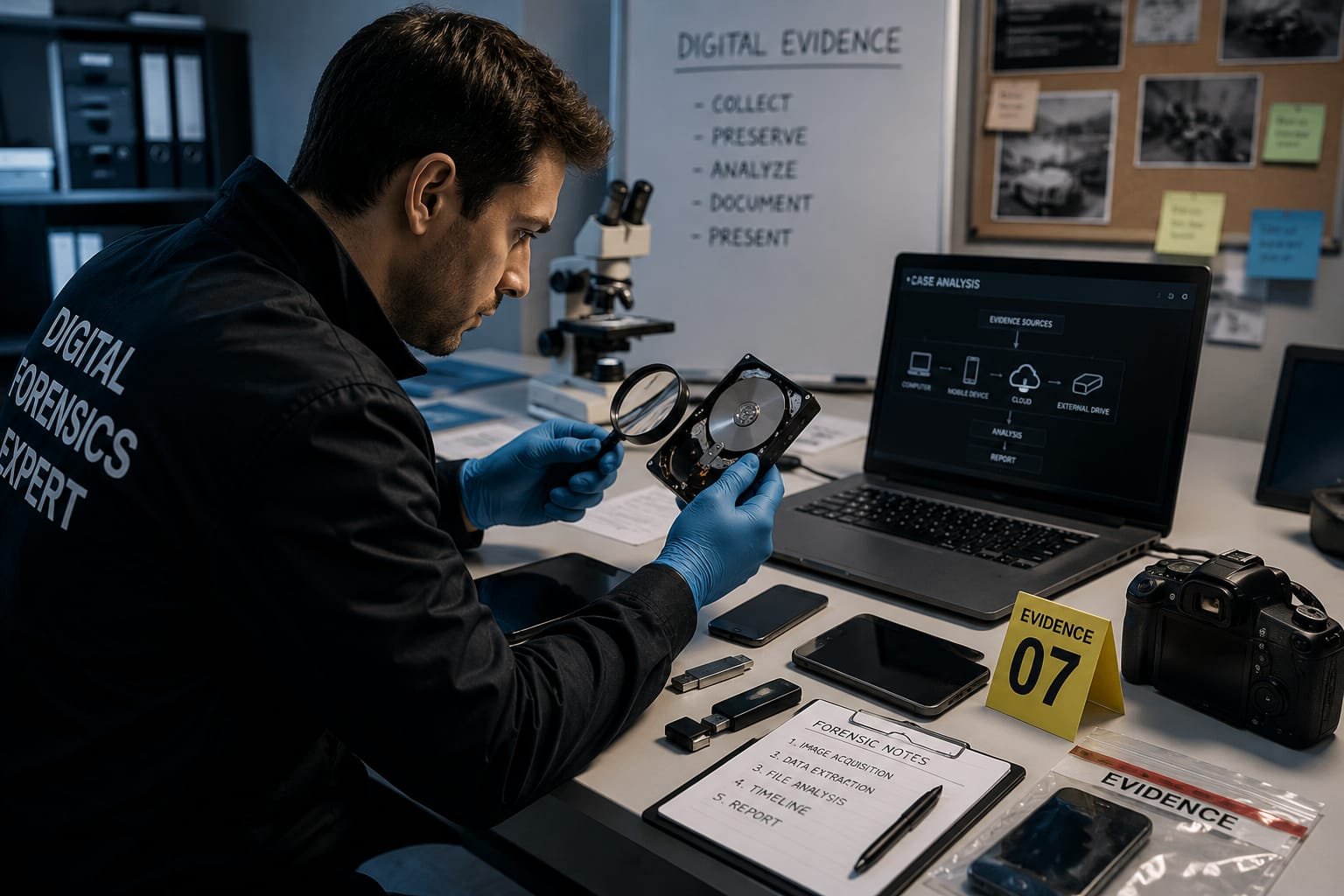
- The person who collects and studies this digital evidence is called a Digital Forensics Expert.
- 👉 In simple words: Digital Forensics Experts investigate cyber crimes and find digital evidence from computers and devices.
Digital Forensics Expert
What Do They Do?
🎓 How to Become a Digital Forensics Expert
These beginner-level courses help students learn computer systems, digital investigations, cyber security basics, and how digital evidence is collected and analyzed.
Diploma in Computer Science and Engineering with Cyber Security
Duration: 1–3 Years
Eligibility: Class 10 Pass
Entrance Exam: Polytechnic Entrance Exam / Merit-Based Admission
Diploma in Information Technology & Cyber Security
Duration: 3 Years
Eligibility: Class 10 Pass
Entrance Exam: Polytechnic Entrance Exam / Merit-Based Admission
Diploma in Computer Science Engineering
Duration: 3 Years
Eligibility: Class 10 Pass
Entrance Exam: Polytechnic Entrance Exam / Merit-Based Admission
📝 Exam Details
(Click on the exam name to see full details)
Polytechnic Entrance Exam Merit-Based AdmissionNote: Many Digital Forensics Experts improve their skills by learning computer systems, cyber security, digital investigations, and methods used to collect and analyze digital evidence.
These degree programs help students learn digital investigations, cyber crime analysis, computer forensics, data recovery, and methods used to collect digital evidence.
B.Sc in Cyber Security / Digital Forensics
Duration: 3–4 Years
Eligibility: 10+2 Pass (Science Stream with Mathematics or Computer Science Preferred)
Entrance Exam: AIFSET / University Entrance Exams
B.Tech in Computer Science Engineering (Digital Forensics)
Duration: 4 Years
Eligibility: 10+2 Pass (Physics, Chemistry, and Mathematics)
Entrance Exam: JEE Main / State Engineering Entrance Exams
Bachelor of Computer Applications (BCA) in Digital Forensics
Duration: 3 Years
Eligibility: 10+2 Pass (Any Stream)
Entrance Exam: CUET-UG / Merit-Based Admission
B.Tech in Computer Science Engineering
Duration: 4 Years
Eligibility: 10+2 Pass (Physics, Chemistry, and Mathematics)
Entrance Exam: JEE Main / State Engineering Entrance Exams
B.Tech in Information Technology
Duration: 4 Years
Eligibility: 10+2 Pass (Physics, Chemistry, and Mathematics)
Entrance Exam: JEE Main / State Engineering Entrance Exams
📝 Exam Details
(Click on the exam name to see full details)
AIFSET JEE Main State Engineering Entrance Exams CUET-UG Merit-Based AdmissionNote: Digital Forensics Experts often strengthen their skills by learning cyber crime investigation, evidence collection, operating systems, networking, and digital forensic tools used by law enforcement and security teams.
Students who complete a diploma in Computer Science, Information Technology, or Cyber Security can join the second year of a bachelor's degree through lateral entry.
B.Tech Lateral Entry (Cyber Security / Information Security)
Duration: 3 Years
Eligibility: Diploma in Computer Science, Information Technology, or Cyber Security
Entrance Exam: State Lateral Entry Entrance Exams
B.Tech Lateral Entry in Computer Science Engineering
Duration: 3 Years
Eligibility: Diploma in Computer Science or Information Technology
Entrance Exam: State Lateral Entry Entrance Exams
B.Tech Lateral Entry in Information Technology
Duration: 3 Years
Eligibility: Diploma in Computer Science or Information Technology
Entrance Exam: State Lateral Entry Entrance Exams
BCA (Lateral Entry) with Cyber Security Specialization
Duration: 2–3 Years
Eligibility: Relevant Diploma in Computing or IT
Entrance Exam: University Entrance Test / Merit-Based Admission
📝 Exam Details
(Click on the exam name to see full details)
State Lateral Entry Exams Merit-Based AdmissionNote: Lateral entry allows diploma holders to directly enter the second year of a degree program and continue building advanced cyber security and networking skills.
These advanced programs help graduates specialize in cyber crime investigation, digital evidence analysis, forensic tools, and legal procedures related to digital crimes.
M.Sc in Digital Forensics
Duration: 2 Years
Eligibility: Graduate (BSc Forensic Science, BSc CS, BCA, or B.Tech)
Entrance Exam: CUET-PG / University Entrance Exam
M.Tech in Cyber Security and Digital Forensics
Duration: 2 Years
Eligibility: Graduate (B.Tech/B.E. in CSE/IT or MCA)
Entrance Exam: GATE / University Entrance Exams
Post Graduate Diploma in Digital Forensics
Duration: 1 Year
Eligibility: Graduate (Technical, Science, or Law Background)
Entrance Exam: Direct Admission / Merit-Based Admission
📝 Exam Details
(Click on the exam name to see full details)
NFSU Entrance Exam CUET-PG GATE University Entrance Exams Merit-Based AdmissionNote: Advanced studies help Digital Forensics Experts work on cyber crime investigations, digital evidence recovery, malware analysis, and forensic research for law enforcement and security organizations.
Note:
(Age limits, marks, and admission process may vary depending on the college or state.
Below are some colleges that offer these courses.
These courses are available in many colleges and universities across India. You can choose colleges based on your location, budget, and entrance exams.)
🏛️ Colleges offering these courses in India
(Tap on a college to view the details)
After Class 10
Silver Oak University, Ahmedabad, Gujarat Government Polytechnic College, Kalamassery, Kerala PSG Polytechnic College, Coimbatore, Tamil NaduAfter 12th Pass (Bachelor's Degrees)
Bharati Vidyapeeth, Pune Parul University, Vadodara, Gujarat Manav Rachna International Institute of Research and Studies, Haryana IIT, Bombay Manipal University, JaipurAfter Diploma (Lateral Entry)
Manav Rachna International Institute of Research and Studies, Haryana Chandigarh University, Uttar Pradesh Lovely Professional University, Punjab CT University, Punjab CUSAT, kochi, KeralaSTEP 1
Imagine you are a Digital Forensics Expert.
STEP 2
Your job is to investigate cyber crimes and find digital evidence.
STEP 3
You examine computers, mobile phones, emails, and other digital devices.
STEP 4
You look for clues to understand what happened and who was involved.
STEP 5
You prepare reports that can help companies or police solve the case.
STEP 6
If you enjoy computers, solving mysteries, and finding clues, this career may suit you.
Where do Digital Forensics Experts work? (Job Roles + Growth)
Digital Forensics Expert work in : Cybersecurity firms, Law enforcement agencies, Government organisations, Banks and financial institutions, Corporate security departments, Consulting firms, and Forensic laboratories.
🟢 Beginner Roles
Cyber Forensics Associate
(After Short-Term Certification / Diploma)
Preserves digital evidence and copies data from seized devices.
Digital Evidence Custodian
(After Diploma / BCA / B.Tech)
Maintains evidence records and follows legal handling procedures.
Mobile Forensics Assistant
(After Diploma / Graduation)
Extracts data from smartphones and helps analyze digital evidence.
Computer Forensics Technician
(After Computer Forensics Training)
Recovers deleted files and examines computer storage devices.
🔵 Mid-Level Roles
Digital Forensics Examiner
(After BCA / B.Tech + Experience)
Investigates devices and recovers hidden or deleted evidence.
Incident Response Analyst
(After BCA / B.Tech + Certification)
Investigates cyber attacks and traces attacker activities.
Cyber Crime Investigator
(After Digital Forensics Training + Experience)
Collects evidence and supports cyber crime investigations.
Malware Forensics Analyst
(After Security & Malware Analysis Training)
Studies malicious software and discovers how attacks occurred.
🟣 Advanced Roles
Digital Forensics Expert / Consultant
(After MCA / M.Tech + Experience)
Presents evidence reports and provides expert forensic advice.
Forensic Investigation Manager
(After Leadership Experience)
Leads teams handling major cyber crime investigations.
Director of Cyber Crime Investigation
(After Senior Leadership Experience)
Oversees large-scale digital forensics and cyber crime operations.
Digital Forensics Companies
Investigate cyber crimes and recover digital evidence from devices.
Law Enforcement Agencies
Analyze digital evidence to support criminal investigations.
Banking & Financial Companies
Investigate fraud cases and trace suspicious digital activities.
Cybersecurity Companies
Examine cyber attacks and identify how security breaches occurred.
Government & Intelligence Agencies
Investigate cyber threats and protect national digital infrastructure.
Remote Digital Forensics Jobs
Analyze digital evidence and support investigations worldwide.
(Click Yes or No for each question)
1. Have you ever heard of hackers stealing information online?
2. Have you ever wondered how investigators find digital clues from computers, phones, or online accounts after a cybercrime happens?
3. Are you interested in solving cybercrime cases?
4. Imagine you are working as a Digital Forensics Expert. Someone has used a person's computer to steal important information. Your job is to investigate the computer and find digital clues that can help you understand what happened. You check files, messages, and other information on the computer. Finally, you find useful evidence and explain what happened. Do you like this type of work?
5. Imagine you are investigating a cybercrime. Important information has been deleted from the computer.You examine computers and try to recover the deleted files. You recover the files that may help with the investigation. Does this excite you?