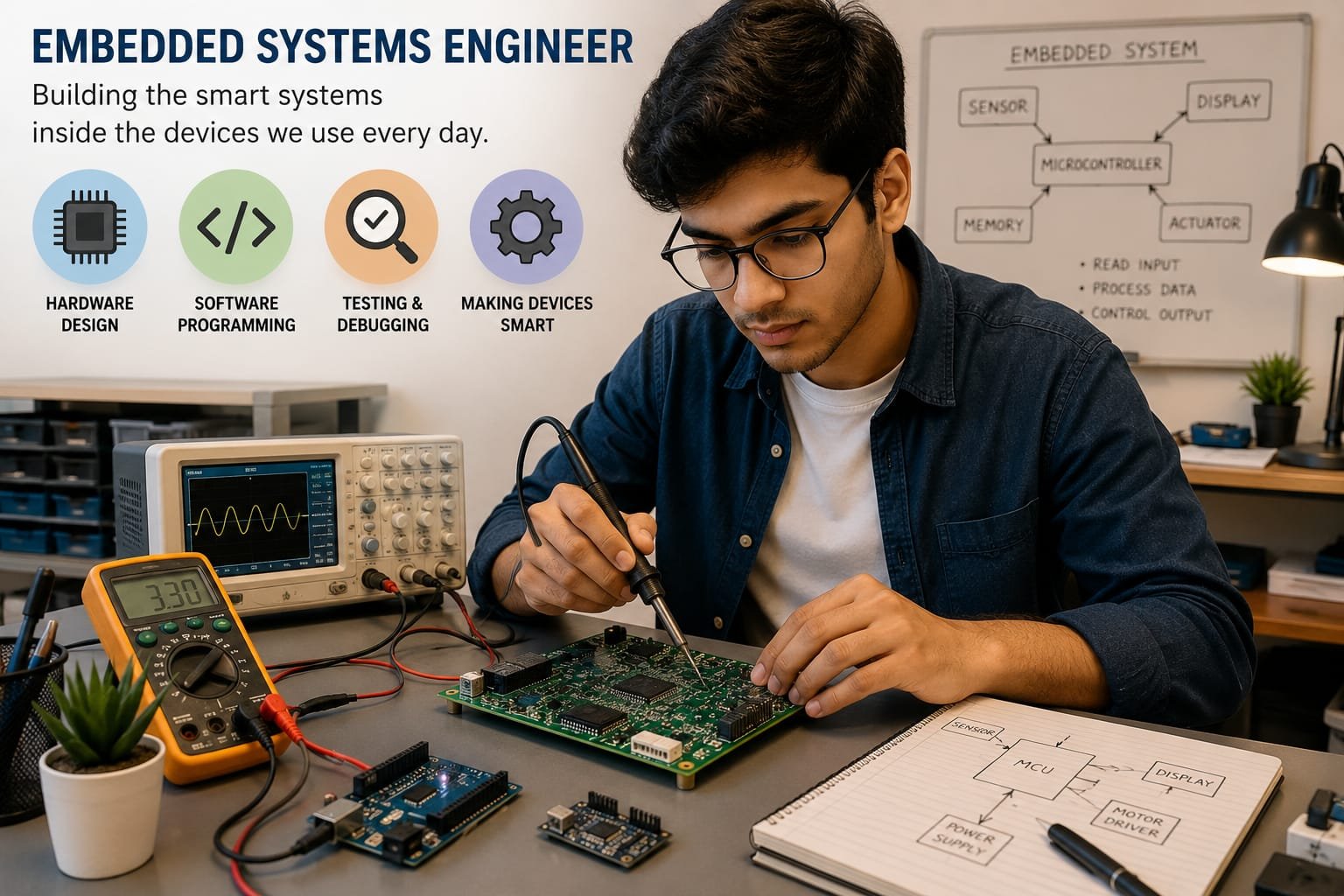
- 'Embedded' simply means built into something. An embedded system is a system built into a device to control how it works.
- Think about an automatic washing machine.
- You put your clothes inside and turn on the machine
- The machine fills the water, spins the clothes and stops at the right time.
- But how does the machine know what to do and when to do it?
- A system inside the machine controls these actions.
- The person who designs and programs these systems is called an Embedded Systems Engineer.
- 👉 In simple words: Embedded Systems Engineers design and program systems that control how electronic devices work.
Embedded Systems Engineer
What Do They Do?
🎓 How to Become an Embedded Systems Engineer
You have two options:
-
Start early with a Diploma
After Class 10, you can choose a relevant diploma course. Complete the diploma and join the second year of an engineering course by applying through lateral entry. -
Finish Class 12
Complete Class 11 and 12, then you can do a B.Tech./B.E. in the relevant field.
These beginner-level courses help students learn electronics, microcontrollers, computer hardware, programming, and embedded systems fundamentals.
Diploma in Electronics Engineering
Duration: 3 Years
Eligibility: Class 10 Pass
Entrance Exam: Polytechnic Entrance Exam / Merit-Based Admission
Diploma in Electronics and Communication Engineering (ECE)
Duration: 3 Years
Eligibility: Class 10 Pass
Entrance Exam: Polytechnic Entrance Exam / Merit-Based Admission
Diploma in Electrical and Electronics Engineering (EEE)
Duration: 3 Years
Eligibility: Class 10 Pass
Entrance Exam: Polytechnic Entrance Exam / Merit-Based Admission
Diploma in Computer Engineering
Duration: 3 Years
Eligibility: Class 10 Pass
Entrance Exam: Polytechnic Entrance Exam / Merit-Based Admission
📝 Exam Details
(Click on the exam name to see full details)
Polytechnic Entrance Exam Merit-Based AdmissionNote: Most Embedded Systems Engineers continue with B.Tech in Electronics, ECE, Electrical Engineering, Embedded Systems, or related fields after diploma studies. Advanced embedded design roles usually require strong programming, electronics, and microcontroller knowledge.
These undergraduate programs help students learn embedded systems, microcontrollers, electronics, programming, hardware-software integration, and real-time system design.
B.Tech in Electronics Engineering
Duration: 4 Years
Eligibility: 10+2 Pass with Physics, Chemistry, and Mathematics (Minimum 45%–50% marks)
Entrance Exam: JEE Main / JEE Advanced / State Engineering Entrance Exams
B.Tech in Electronics and Communication Engineering (ECE)
Duration: 4 Years
Eligibility: 10+2 Pass with Physics, Chemistry, and Mathematics (Minimum 45%–50% marks)
Entrance Exam: JEE Main / JEE Advanced / State Engineering Entrance Exams
B.Tech in Computer Science and Engineering (Internet of Things)
Duration: 4 Years
Eligibility: 10+2 Pass with Physics, Chemistry, and Mathematics (Minimum 50%–60% marks)
Entrance Exam: JEE Main / University Aptitude Tests / State Engineering Entrance Exams
B.Tech in Electrical and Electronics Engineering (EEE)
Duration: 4 Years
Eligibility: 10+2 Pass with Physics, Chemistry, and Mathematics (Minimum 45%–50% marks)
Entrance Exam: JEE Main / JEE Advanced / State Engineering Entrance Exams
B.Tech in Embedded System
Duration: 4 Years
Eligibility: 10+2 Pass with Physics, Chemistry, and Mathematics (Minimum 45%–50% marks)
Entrance Exam: JEE Main / JEE Advanced / State Engineering Entrance Exams
📝 Exam Details
(Click on the exam name to see full details)
JEE Main JEE Advanced State Engineering Entrance ExamsNote: You do not need a specialized Embedded Systems degree to enter this field. B.Tech in ECE, EEE, CSE (IoT), Instrumentation, or related branches can lead to Embedded Systems Engineering careers when combined with programming, microcontroller, and hardware development skills.
These lateral-entry programs help diploma holders strengthen their knowledge in embedded systems, electronics, programming, microcontrollers, hardware design, and real-time system development.
B.Tech Lateral Entry in Electronics and Communication Engineering (ECE)
Duration: 3 Years (Direct Entry into 2nd Year)
Eligibility: 3-Year Engineering Diploma in Electronics, ECE, or related technical branches with at least 45% marks
Entrance Exam: State Lateral Entry Entrance Tests (JELET, ECET, LEET, etc.)
B.Tech Lateral Entry in Electrical and Electronics Engineering (EEE)
Duration: 3 Years (Direct Entry into 2nd Year)
Eligibility: 3-Year Engineering Diploma in Electrical, Electronics, ECE, or related technical branches with at least 45% marks
Entrance Exam: State Lateral Entry Entrance Tests (ECET, JELET, LEET, etc.)
B.Tech Lateral Entry in Electronics Engineering
Duration: 3 Years (Direct Entry into 2nd Year)
Eligibility: 3-Year Engineering Diploma in Computer Science, Electronics, Electrical, ECE, or related branches
Entrance Exam: State Lateral Entry Entrance Tests
Note: Embedded Systems Engineers are commonly recruited from ECE, EEE, Computer Science, IoT, and related branches. During your degree, focus on C/C++ programming, microcontrollers, RTOS, embedded Linux, and hands-on hardware projects to build industry-ready skills.
These advanced programs help graduates specialize in embedded systems, firmware development, real-time operating systems (RTOS), IoT devices, microcontrollers, and hardware-software integration.
M.Tech in Embedded Systems
Duration: 2 Years
Eligibility: B.Tech / B.E. in ECE, EEE, CSE, IT, Instrumentation, Electronics, or related branches
Entrance Exam: GATE / State PGCET / University PG Entrance Tests
M.Tech in VLSI & Embedded Systems
Duration: 2 Years
Eligibility: B.Tech / B.E. in Electronics, ECE, EEE, Instrumentation, or related branches
Entrance Exam: GATE / University PG Entrance Tests
PG Diploma in Embedded System Design
Duration: 6 Months – 1 Year
Eligibility: B.Tech / B.E. in ECE, EEE, CSE, IT, EI, or related branches
Entrance Exam: Institutional Entrance Tests / Industry-Sponsored Selection Tests (e.g., C-DAC CCAT)
Note: Higher studies are optional for Embedded Systems Engineers, but they can help you specialize in areas such as firmware development, RTOS, IoT systems, automotive electronics, industrial automation, and advanced embedded product design.
Note:
(Age limits, marks, and admission process may vary depending on the college or state.
Below are some colleges that offer these courses.
These courses are available in many colleges and universities across India. You can choose colleges based on your location, budget, and entrance exams.)
🏛️ Colleges offering these courses in India
(Tap on a college to visit the official website)
After Class 10
Government Polytechnic, Kasargod, Kerala Government Polytechnic, Pune Parul University, Vadodara, Gujarat PSG Polytechnic College, Coimbatore, Tamil NaduAfter Class 12
Indian Institute of Technology (IIT), Varanasi Vellore Institute of Technology (VIT), Vellore, Tamil Nadu SRM Institute of Science and Technology, Tamil Nadu Indian Institute of Technology (IIT), Madras, Tamil Nadu VIT-AP, Andra pradesh Galgotias University, Noida, UPAfter Diploma (Lateral Entry)
Chandigarh University, Punjab Lovely Professional University (LPU), Punjab National Institute of Electronics & Information Technology (NIELIT), New DelhiAfter Graduation
SRM Institute of Science and Technology, Tamil Nadu Vellore Institute of Technology (VIT), Vellore, Tamil Nadu Cochin University ipof Science & Technology (CUSAT), Kochi, Kerala COEP Technology University, Pune, Maharashtra National Institute of Electronics & Information Technology (NIELIT), Kozhikode, KeralaSTEP 1
Imagine you are working as an Embedded Systems Engineer.
STEP 2
Your company asks you to make a smart watch.
STEP 3
You decide what the watch should do and how it should work.
STEP 4
You create the smart system inside the watch that controls all its functions.
STEP 5
You test whether the watch can count steps when you walk, track health data, and display messages correctly.
STEP 6
If something does not work properly, you fix it and test it again.
STEP 7
If you enjoy electronics, technology, and building smart devices, this career may be right for you.
Where do Embedded Systems Engineers work? (Job Roles + Growth)
Embedded Systems Engineers work in : Electronics companies, Embedded systems companies, Automotive companies, Consumer electronics companies, Medical device companies, Aerospace companies, Industrial automation companies, and IoT companies.
🟢 Beginner Roles
Junior Firmware Tester
(After Short-Term Certification / Diploma)
Runs hardware tests and installs basic firmware on devices.
Graduate Hardware Engineer Trainee
(After Diploma / B.Tech)
Tests circuit boards and assists senior engineers with product development.
🔵 Mid-Level Roles
Embedded Software Engineer
(After B.Tech + Experience)
Develops firmware that controls smart electronic devices.
IoT Solutions Architect
(After B.Tech + Industrial Certification)
Connects sensors and devices to cloud-based networks.
🟣 Advanced Roles
RTOS Expert
(After M.Tech / Advanced Specialization)
Builds real-time software for automobiles and medical equipment.
VP of Hardware Systems
(After Advanced Executive Program + Experience)
Leads engineering teams and manages smart product development.
Consumer Electronics Companies
Build smart home and electronic devices.
Automotive Technology Companies
Develop software for modern vehicles.
IoT & Smart Device Companies
Create connected smart devices and sensors.
Medical Equipment Companies
Design software for medical devices.
Aerospace & Defense Organizations
Build systems for aircraft and satellites.
Industrial Automation & Robotics Companies
Develop robots and automated machines.
(Click Yes or No for each question)
1. Have you ever wondered how a smart watch, smart TV, or washing machine knows what to do?
2. Are you interested in learning how electronic devices work?
3. Did you know that many electronic devices have a smart system inside that controls how they work?
4. Imagine you are working as an Embedded Systems Engineer for a company that makes washing machines. The company wants the washing machine to automatically control the washing time, water level, and spinning speed. Your job is to create the software that controls these functions. Are you interested in doing this work?
5. A TV-making company wants to turn its regular TVs into Smart TVs, so they ask you for help. You create the software that makes the TV smart. This software helps the TV connect to the internet, watch OTT movies and shows, and use different apps. Once the TV is released, people start using it. Would you enjoy doing this kind of work?