- Imagine a company wants to build a robot that can help workers in a factory.
- The robot must move, pick up objects, and works correctly.
- Robots have motors, sensors, electronic parts, mechanical structures, and software that controls their actions.
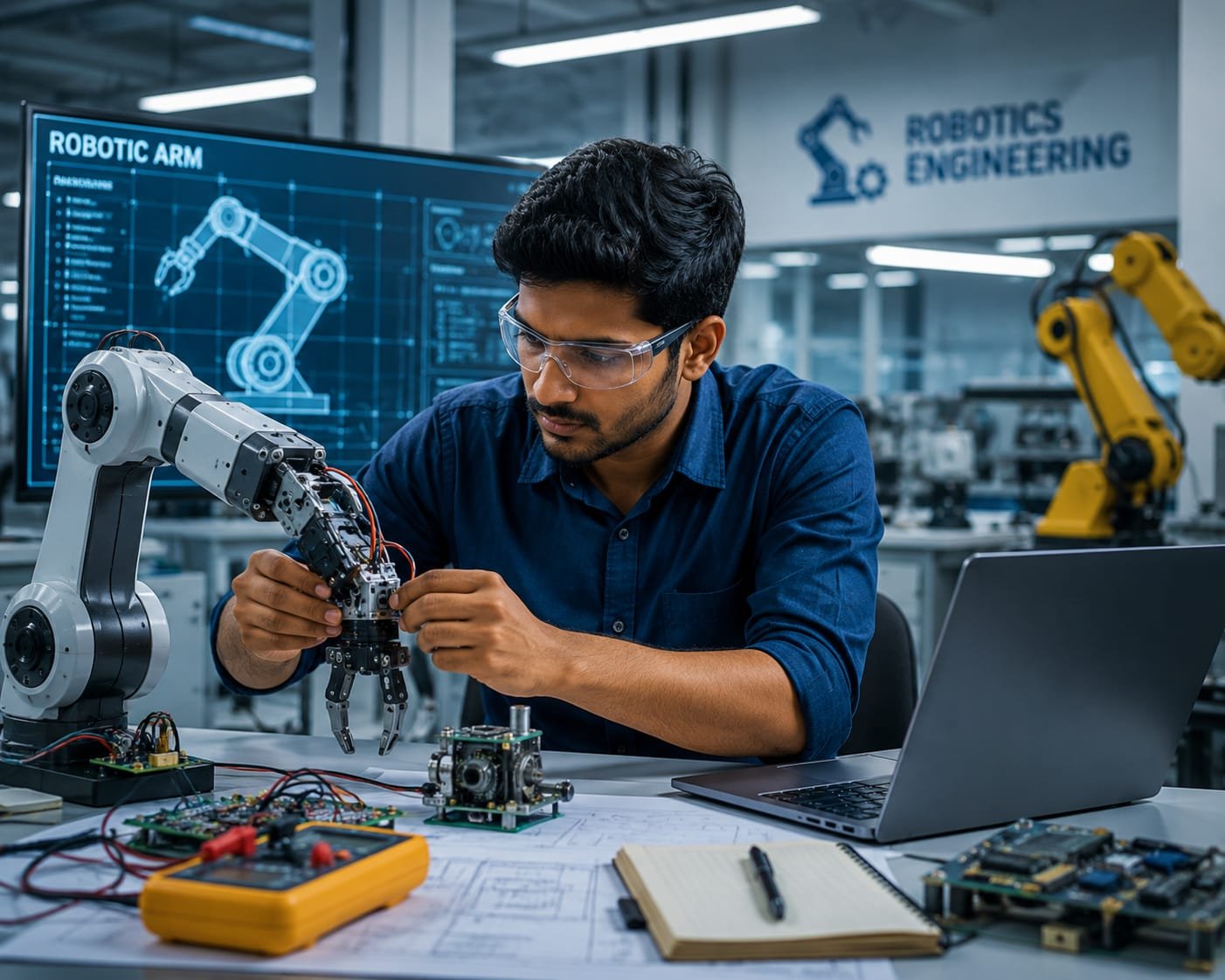
- The person who designs, develops and tests these robotic systems is called a Robotics Engineer.
- 👉 In simple words: Robotics Engineers design, build, program and test robots that can perform useful tasks.
Robotics Engineer
What Do They Do?
🎓 How to Become a Robotics Engineer
You have two options:
-
Start early with a Diploma
After Class 10, you can choose a relevant diploma course. Complete the diploma and join the second year of an engineering course by applying through lateral entry. -
Finish Class 12
Complete Class 11 and 12, then you can do a B.Tech./B.E. in the relevant field.
These diploma courses help students build a foundation in robotics, mechanical systems, electronics, automation, and industrial technology.
Diploma in Robotics & Automation
Duration: 3 Years
Eligibility: Class 10 Pass
Entrance Exam: Polytechnic Entrance Exam / Merit-Based Admission
Diploma in Mechatronics Engineering
Duration: 3 Years
Eligibility: 10th Pass with Science and Mathematics (Minimum 35%–45% marks)
Entrance Exam: State-level Polytechnic Entrance Exams / Merit-Based Admission
Diploma in Mechanical Engineering
Duration: 3 Years
Eligibility: 10th Pass with minimum 35%–45% marks
Entrance Exam: State-level Polytechnic Entrance Exams / Merit-Based Admission
Diploma in Electrical / Electronics Engineering
Duration: 3 Years
Eligibility: 10th Pass with minimum 35%–45% marks
Entrance Exam: State-level Polytechnic Entrance Exams / Merit-Based Admission
📝 Exam Details
(Click on the exam name to see full details)
Polytechnic Entrance Exam Merit-Based AdmissionNote: After Diploma, you won't usually get a direct core Robotics Engineer role.
Most students continue through B.Tech Lateral Entry or gain additional skills in PLC programming, automation, industrial robotics, and CAD tools.
These degree programs help students learn robotics, automation, electronics, mechanical systems, embedded systems, and intelligent machine design.
B.Tech in Robotics Engineering
Duration: 4 Years
Eligibility: 10+2 Pass with Physics, Chemistry, and Mathematics (Minimum 45%–50% marks)
Entrance Exam: JEE Main / State Engineering Entrance Exams
B.Tech in Robotics and Automation
Duration: 4 Years
Eligibility: 10+2 Pass with Physics, Chemistry, and Mathematics (Minimum 45%–50% marks)
Entrance Exam: JEE Main / JEE Advanced / State Engineering Entrance Exams
B.Tech in Robotics and Artificial Intelligence
Duration: 4 Years
Eligibility: 10+2 Pass with Physics, Chemistry, and Mathematics (Minimum 45%–50% marks)
Entrance Exam: JEE Main / State Engineering Entrance Exams
B.Tech in Mechatronics Engineering
Duration: 4 Years
Eligibility: 10+2 Pass with Physics, Chemistry, and Mathematics (Minimum 45%–50% marks)
Entrance Exam: JEE Main / JEE Advanced / State Engineering Entrance Exams
B.Tech in Mechanical Engineering
Duration: 4 Years
Eligibility: 10+2 Pass with Physics, Chemistry, and Mathematics (Minimum 45%–50% marks)
Entrance Exam: JEE Main / JEE Advanced / State Engineering Entrance Exams
B.Tech in Electronics and Communication Engineering (ECE)
Duration: 4 Years
Eligibility: 10+2 Pass with Physics, Chemistry, and Mathematics (Minimum 45%–50% marks)
Entrance Exam: JEE Main / JEE Advanced / State Engineering Entrance Exams
📝 Exam Details
(Click on the exam name to see full details)
JEE Main JEE Advanced State Engineering Entrance ExamsNote: Students can also become Robotics Engineers through traditional engineering branches such as Electronics (ECE), Electrical Engineering, or Computer Science Engineering. However, they should build additional skills in robotics programming, embedded systems, automation, control systems, and hands-on robotics projects.
These lateral-entry degree programs help diploma holders advance their knowledge in robotics, automation, mechanical systems, electronics, and intelligent machines.
B.Tech Lateral Entry in Robotics and Automation
Duration: 3 Years (Direct Entry into 2nd Year)
Eligibility: 3-Year Engineering Diploma in Mechatronics, Mechanical, or Automation-related fields
Entrance Exam: State Lateral Entry Entrance Tests (JELET, ECET, etc.)
B.Tech Lateral Entry in Robotics and Artificial Intelligence
Duration: 3 Years (Direct Entry into 2nd Year)
Eligibility: 3-Year Engineering Diploma in Mechatronics, Mechanical, or Automation-related fields
Entrance Exam: State Lateral Entry Entrance Tests (JELET, ECET, etc.)
B.Tech Lateral Entry in Mechatronics Engineering
Duration: 3 Years
Eligibility: 3-Year Engineering Diploma in Mechatronics, Mechanical, or Electronics Engineering
Entrance Exam: State Lateral Entry Entrance Tests
B.Tech Lateral Entry in Mechanical Engineering
Duration: 3 Years
Eligibility: 3-Year Engineering Diploma in Mechanical or Production Engineering
Entrance Exam: State Lateral Entry Entrance Tests
B.Tech Lateral Entry in Electronics and Communication (ECE) Engineering
Duration: 3 Years
Eligibility: 3-Year Engineering Diploma in Mechanical or Production Engineering
Entrance Exam: State Lateral Entry Entrance Tests
Note: After completing a diploma, lateral entry into a B.Tech program is one of the most common pathways to become a Robotics Engineer.
Students should also build practical skills in robotics programming, PLCs, embedded systems, CAD design, automation, and industrial robotics.
These postgraduate programs help engineers specialize in robotics, automation, intelligent systems, control engineering, and advanced industrial technologies.
M.Tech in Robotics Engineering
Duration: 2 Years
Eligibility: B.Tech / B.E. in Mechanical, Mechatronics, ECE, Electrical, or Computer Science Engineering
Entrance Exam: GATE / CUET-PG / University-Specific PG Entrance Exams
M.Tech in Robotics and Automation
Duration: 2 Years
Eligibility: B.Tech / B.E. in Mechanical, Mechatronics, ECE, Electrical, or Computer Science Engineering
Entrance Exam: GATE / State PGCET / University-Specific PG Entrance Exams
M.Tech in Robotics and Artificial Intelligence
Duration: 2 Years
Eligibility: B.Tech / B.E. in Mechanical, Mechatronics, ECE, Electrical, or Computer Science Engineering
Entrance Exam: GATE / University-Specific PG Entrance Exams
M.Tech in Mechatronics Engineering
Duration: 2 Years
Eligibility: B.Tech / B.E. in Core Engineering Disciplines
Entrance Exam: GATE / State PGCET
M.Tech in Control Systems / Instrumentation
Duration: 2 Years
Eligibility: B.Tech / B.E. in Electrical, Electronics, or Instrumentation Engineering
Entrance Exam: GATE / State PGCET
📝 Exam Details
(Click on the exam name to see full details)
GATE CUET-PG State PGCET University PG Entrance ExamsNote: Postgraduate studies help Robotics Engineers gain expertise in robotics design, artificial intelligence, automation systems, control engineering, machine vision, embedded systems, and advanced industrial robotics.
Note:
(Age limits, marks, and admission process may vary depending on the college or state.
Below are some colleges that offer these courses.
These courses are available in many colleges and universities across India. You can choose colleges based on your location, budget, and entrance exams.)
🏛️ Colleges offering these courses in India
(Tap on a college to visit the official website)
After Class 10
Parul University, Vadodara, Gujarat Arka Jain University, Jamshedpur Government Polytechnic College, Kalamassery, Ernakulam Government Polytechnic College, Pune, MaharashtraAfter Class 12
M.S.Ramaiah University of Applied Sciences, Bengaluru Lovely Professional University, Punjab Manipal University, Jaipur REVA University, Bengaluru, Karnataka Indian Institute of Technology (IIT), Hyderabad Indian Institute of Technology (IIT), Dharwad, KarnatakaAfter Diploma (Lateral Entry)
Lovely Professional University, Punjab Symbiosis Institute of Technology (SIT), Pune CHRIST University, Bengaluru, Karnataka CUSAT, Kochi, Kerala Chandigarh Engineering College, Mohali, PunjabAfter Graduation
Ramaiah University of Applied Sciences (RUAS), bengaluru, Karnataka Indian Institute of Technology (IIT), Guwahati, Assam National Institute of Technical Teachers Training and Research (NITTTR), Chandigarh Manipal Institute of Technology (MIT), Manipal, Karnataka Indian Institute of Space Science and Technology (IIST), TrivandrumSTEP 1
Imagine you are working as a Robotics Engineer.
STEP 2
Your company is building a robot for a factory.
STEP 3
You help design the robot's body, motors, and sensors.
STEP 4
You assemble the robot and connect its electronic parts.
STEP 5
You test whether the robot can move and perform its tasks correctly.
STEP 6
If problems occur, you improve the design and test it again.
STEP 7
If you enjoy building machines, solving problems, and working with technology, this career may be right for you.
Where do Robotics Engineers work? (Job Roles + Growth)
Robotics Engineers work in : Robotics companies, Industrial automation companies, Manufacturing plants, Automotive companies, Aerospace companies, Drone companies, Research laboratories, and Healthcare robotics companies.
🟢 Beginner Roles
Junior Robotics Technician
(After Short-Term Certification / Diploma)
Assembles robotic components and performs basic testing and maintenance.
Graduate Trainee Engineer (Robotics)
(After Diploma / B.Tech)
Assists in robot design, testing, and system integration projects.
🔵 Mid-Level Roles
Robotics Design & Development Engineer
(After B.Tech + Industrial Certification)
Designs robotic structures, mechanisms, and automation systems.
Robotic Systems Automation Engineer
(After B.Tech + Experience)
Programs and integrates industrial robots for automated operations.
🟣 Advanced Roles
Lead Robotics Systems Architect
(After M.Tech + Advanced Specialization)
Leads the design and integration of large-scale robotic systems.
Head of Robotics Engineering & Operations
(After Senior Leadership Experience)
Manages robotics teams and oversees industrial automation projects.
Robotics Companies
Design, build, and test robotic systems for industrial and commercial applications.
Manufacturing & Automation Companies
Develop robotic production systems and automate factory operations.
Automotive & Autonomous Systems Companies
Build robotic platforms, autonomous machines, and smart mobility solutions.
Healthcare & Medical Robotics
Create robotic devices used in surgery, rehabilitation, and patient care.
Space, Defense & Research Organizations
Develop advanced robotic systems for exploration, defense, and scientific research.
Global Robotics Engineering Jobs
Work on robotics design, automation, and system integration projects worldwide.
(Click Yes or No for each question)
1. Have you ever seen a robot doing a job?
2. Have you ever wondered how robots are made?
3. Are you interested in learning how robots are made?
4. Imagine you are working as a Robotics Engineer for a company. The company wants to build a robot that can pick up and move heavy boxes in a factory. Your job is to design and build the robot and make sure it can move, pick up the boxes, and place them safely. Would you enjoy doing this kind of work?
5. A hospital wants to use a robot to help doctors during surgery. The robot needs to move its arms carefully and accurately during the operation. Your job is to design and test the robot so it can move correctly and safely. Are you interested in doing this?