- Imagine a robot working in a factory.
- Robots can do many tasks automatically.
- To do these tasks, a software is programmed inside the robot.
- The software tells the robot what to do and how to do it.
- The person who builds this software is called a Robotics Software Engineer.
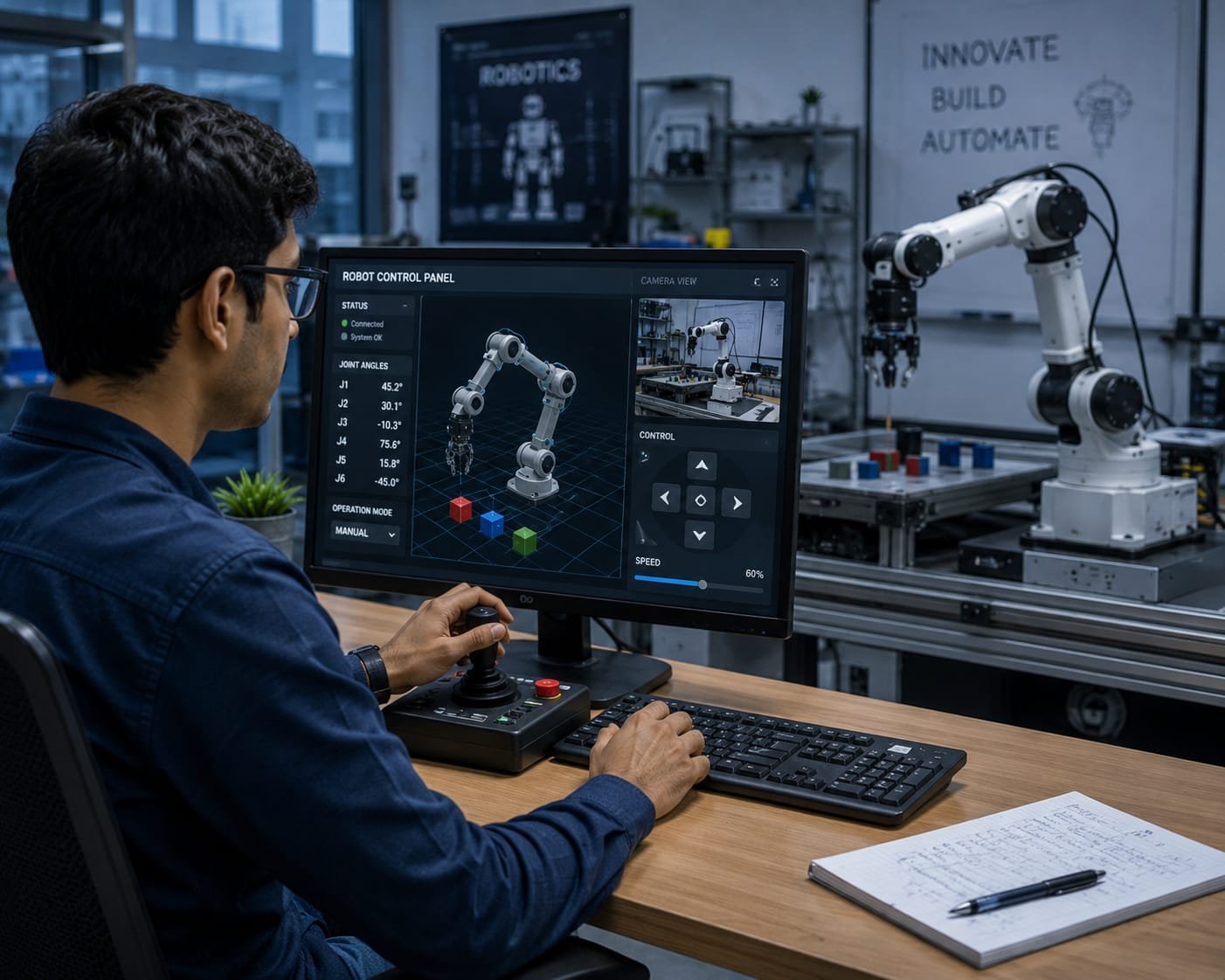
- 👉 In simple words: Robotics Software Engineers build software that helps robots move, sense their surroundings, and perform tasks automatically.
Robotics Software Engineer
What Do They Do?
🎓 How to Become a Robotics Software Engineer
You have two options:
-
Start early with a Diploma
After Class 10, you can choose a relevant diploma course. Complete the diploma and join the second year of an engineering course by applying through lateral entry. -
Finish Class 12
Complete Class 11 and 12, then you can do a B.Tech./B.E. in the relevant field.
These beginner-level courses help students learn programming, electronics, robotics fundamentals, automation, and computer systems.
Diploma in Computer Science Engineering (CSE)
Duration: 3 Years
Eligibility: Class 10 Pass
Entrance Exam: Polytechnic Entrance Exam / Merit-Based Admission
Diploma in Automation and Robotics
Duration: 3 Years
Eligibility: Class 10 Pass
Entrance Exam: Polytechnic Entrance Exam / Merit-Based Admission
Diploma in Electronics and Communication Engineering (ECE)
Duration: 3 Years
Eligibility: Class 10 Pass
Entrance Exam: Polytechnic Entrance Exam / Merit-Based Admission
Diploma in Information Technology
Duration: 3 Years
Eligibility: Class 10 Pass
Entrance Exam: Polytechnic Entrance Exam / Merit-Based Admission
Diploma in Artificial Intelligence & Machine Learning
Duration: 3 Years
Eligibility: Class 10 Pass
Entrance Exam: Polytechnic Entrance Exam / Merit-Based Admission
📝 Exam Details
(Click on the exam name to see full details)
Polytechnic Entrance Exam Merit-Based AdmissionNote: After completing a diploma, most students continue through B.Tech Lateral Entry or gain advanced skills in programming, robotics, ROS, Linux, AI, and automation before becoming Robotics Software Engineers.
These undergraduate courses help students learn robotics, programming, artificial intelligence, automation, embedded systems, and software development.
B.Tech in Robotics and Artificial Intelligence (AI)
Duration: 4 Years
Eligibility: 10+2 Pass (with Physics, Chemistry, and Mathematics)
Entrance Exam: JEE Main / JEE Advanced / State Engineering Entrance Exams
B.Tech in Computer Science and Engineering (CSE)
Duration: 4 Years
Eligibility: 10+2 Pass (with Physics, Chemistry, and Mathematics)
Entrance Exam: JEE Main / JEE Advanced / State Engineering Entrance Exams
B.Tech in Robotics & Automation
Duration: 4 Years
Eligibility: 10+2 Pass (with Physics, Chemistry, and Mathematics)
Entrance Exam: JEE Main / JEE Advanced / State Engineering Entrance Exams
B.Tech in Electronics and Communication Engineering (ECE)
Duration: 4 Years
Eligibility: 10+2 Pass (with Physics, Chemistry, and Mathematics)
Entrance Exam: JEE Main / JEE Advanced / State Engineering Entrance Exams
Bachelor of Computer Applications (BCA)
Duration: 3 Years
Eligibility: 10+2 Pass (Any Stream; Mathematics or Computer Science Preferred)
Entrance Exam: CUET-UG / State-level CET / University Merit-Based Admission
B.Sc in Computer Science (with AI & Robotics Electives)
Duration: 3 Years
Eligibility: 10+2 Pass (Science Stream with Mathematics)
Entrance Exam: CUET-UG / State-level CET / University Merit-Based Admission
📝 Exam Details
(Click on the exam name to see full details)
JEE Main JEE Advanced State Engineering Entrance Exams CUET-UG State-level CET Merit-Based AdmissionNote: B.Tech is the most direct route to becoming a Robotics Software Engineer.
Students from BCA and B.Sc backgrounds can also enter this field by developing strong programming skills and gaining experience in robotics, AI, ROS, Linux, and software development projects.
These pathways help diploma holders continue their education and develop advanced skills in robotics, programming, artificial intelligence, and automation.
B.Tech Lateral Entry (Computer Science Engineering)
Duration: 3 Years
Eligibility: Diploma in Engineering (CSE, IT, ECE, Robotics, or Related Fields)
Entrance Exam: State Lateral Entry Exams (e.g., JELET, ECET, LET)
B.Tech Lateral Entry (Robotics & Automation)
Duration: 3 Years
Eligibility: Diploma in Engineering (CSE, IT, ECE, Robotics, or Related Fields)
Entrance Exam: State Lateral Entry Exams (e.g., JELET, ECET, LET)
B.Tech Lateral Entry (Robotics & Artificial Intelligence)
Duration: 3 Years
Eligibility: Diploma in Engineering (CSE, IT, ECE, Robotics, or Related Fields)
Entrance Exam: State Lateral Entry Exams (e.g., JELET, ECET, LET)
B.Tech Lateral Entry (Electronics & Communication Engineering)
Duration: 3 Years
Eligibility: Diploma in Engineering (CSE, IT, ECE, Robotics, or Related Fields)
Entrance Exam: State Lateral Entry Exams (e.g., JELET, ECET, LET)
B.Tech Lateral Entry (Information Technology)
Duration: 3 Years
Eligibility: Diploma in Engineering (CSE, IT, ECE, Robotics, or Related Fields)
Entrance Exam: State Lateral Entry Exams (e.g., JELET, ECET, LET)
📝 Exam Details
(Click on the exam name to see full details)
State Lateral Entry Exams Merit-Based Admission University Entrance ExamNote: Diploma holders usually enter Robotics Software Engineering through B.Tech Lateral Entry.
Along with academics, students should build strong skills in programming, Linux, ROS, robotics simulation, AI, and software development projects.
These postgraduate and advanced specialization programs help students gain expertise in robotics software, artificial intelligence, autonomous systems, machine learning, and intelligent automation.
M.Tech in Robotics Engineering
Duration: 2 Years
Eligibility: B.Tech / B.E. in Mechanical, Mechatronics, ECE, Electrical, or Computer Science Engineering
Entrance Exam: GATE / CUET-PG / University-Specific PG Entrance Exams
M.Tech in Robotics and Automation
Duration: 2 Years
Eligibility: B.Tech / B.E. in Mechanical, Mechatronics, ECE, Electrical, or Computer Science Engineering
Entrance Exam: GATE / State PGCET / University-Specific PG Entrance Exams
M.Tech in Robotics and Artificial Intelligence
Duration: 2 Years
Eligibility: B.Tech / B.E. in Mechanical, Mechatronics, ECE, Electrical, or Computer Science Engineering
Entrance Exam: GATE / University-Specific PG Entrance Exams
M.Tech in Computer Science and Engineering (AI & ML)
Duration: 2 Years
Eligibility: B.Tech / B.E. in Computer Science Engineering, Information Technology, or a related engineering discipline
Entrance Exam: GATE / University-Specific PG Entrance Exams
Master of Computer Applications (MCA)
Duration: 2 Years
Eligibility: Graduate (BCA, B.Sc Computer Science, or Any Degree with Mathematics)
Entrance Exam: NIMCET / State-level MCA Entrance Exams / University Entrance Exams
📝 Exam Details
(Click on the exam name to see full details)
GATE NIMCET State PG Engineering Entrance Exams State MCA Entrance Exams University Entrance Exams Merit-Based AdmissionNote: Most Robotics Software Engineers start their careers after a bachelor's degree.
Postgraduate programs are useful for specializing in robotics, artificial intelligence, autonomous systems, computer vision, and advanced software development roles.
Note:
(Age limits, marks, and admission process may vary depending on the college or state.
Below are some colleges that offer these courses.
These courses are available in many colleges and universities across India. You can choose colleges based on your location, budget, and entrance exams.)
🏛️ Colleges offering these courses in India
(Tap on a college to visit the official website)
After Class 10
Government Polytechnic, Adityapur, Jharkhand Parul University, Vadodara, Gujarat Government Polytechnic College, Kalamassery, Kerala Government Polytechnic College, Lucknow, UP Lovely Professional University, PunjabAfter Class 12
Symbiosis Institute of Technology, Pune, Maharashtra SRM Institute of Science and Technology, Tamil Nadu Lovely Professional University (LPU), Punjab Indian Institute of Technology (IIT), Dharwad, Karnataka Thakur College of Science & Commerce, Mumbai, Maharashtra Yenapoya University, Bengaluru, KarnatakaAfter Diploma (Lateral Entry)
Chandigarh University, Punjab Lovely Professional University, Punjab Symbiosis Institute of Technology (SIT), Pune CUSAT, Kochi, Kerala Manav Rachna International Institute of Research and Studies, HaryanaAfter Graduation
Ramaiah University of Applied Sciences (RUAS), bengaluru, Karnataka Manipal Institute of Technology (MIT), Manipal, Karnataka Indian Institute of Technology (IIT), Guwahati, Assam Indian Institute of Technology, Kanpur, UP Chandigarh University, Uttar Pradesh Yenapoya University, Bengaluru, KarnatakaSTEP 1
Imagine you are working as a Robotics Software Engineer at a robotics company.
STEP 2
Your team is building a robot that can perform tasks automatically.
STEP 3
You write software that tells the robot how to move and perform its work.
STEP 4
You test the robot to make sure it follows the instructions correctly.
STEP 5
If the robot makes mistakes, you find the problem and improve the software.
STEP 6
You may also help robots use sensors, cameras, and AI to work more intelligently.
STEP 7
If you enjoy programming, robotics, and solving technical problems, this career may suit you.
Where do Robotics Software Engineers work? (Job Roles + Growth)
Robotics Software Engineers work in : Robotics companies, Autonomous vehicle companies, Drone companies, Industrial automation companies, AI companies, Research laboratories, and Healthcare robotics companies.
🟢 Beginner Roles
Junior Robotics Software Engineer
(After Short-Term Certification / Diploma)
Writes basic software to control robot movements and simple tasks.
Robotics Software Analyst Trainee
(After Diploma / BCA / B.Tech)
Assists senior engineers with robot testing and simulation tasks.
🔵 Mid-Level Roles
Robotics Software Engineer
(After BCA / B.Tech + ROS Certification)
Develops software that helps robots perform tasks automatically.
Robotics Software Administrator
(After BCA / B.Tech + Experience)
Manages robot software systems, updates, and testing environments.
🟣 Advanced Roles
Principal AI Robotics Architect
(After MCA / M.Tech + Advanced Robotics Experience)
Designs intelligent robotics systems powered by AI and automation.
Head of Robotics Software Operations
(After Senior Leadership Experience)
Leads engineering teams building advanced robotic products.
Robotics Companies
Develop software that helps industrial and service robots perform tasks automatically.
Manufacturing & Automation Companies
Build and improve robotic systems used in factories and production lines.
Automotive & Autonomous Vehicle Companies
Create software for self-driving vehicles, smart navigation, and robotic automation.
Healthcare & Medical Robotics
Develop software for surgical robots and medical automation systems.
Space, Defense & Research Organizations
Build robotic systems for exploration, defense, and advanced research.
Remote Robotics Software Jobs
Develop, test, and maintain robotics software for global companies.
(Click Yes or No for each question)
1. Have you ever seen a robot in a factory, hospital, warehouse, or in videos online?
2. Have you ever wondered how a robot functions?
3. Do you know that every robot needs software to tell it how to move and perform tasks?
4. Imagine you are working as a Robotics Software Engineer. Your company makes robots, and your job is to create the software used in them. The software gives the robot instructions so it knows what to do. You work with a team to create and test the software. Once it is ready, the software is added to the robots to help them perform their tasks. Would you enjoy doing this kind of work?
5. A robot used in a hospital suddenly stops working, and they call you for help. You check the robot and find that the problem is with the software. You update the software and fix the problem. Now the robot starts working again. Would you enjoy doing this kind of work?