- Imagine you order a product online.
- Before it reaches your home, it may travel through warehouses, trucks, ships or airplanes.
- Someone has to plan how the product will be stored, transported, and delivered to your home on time.
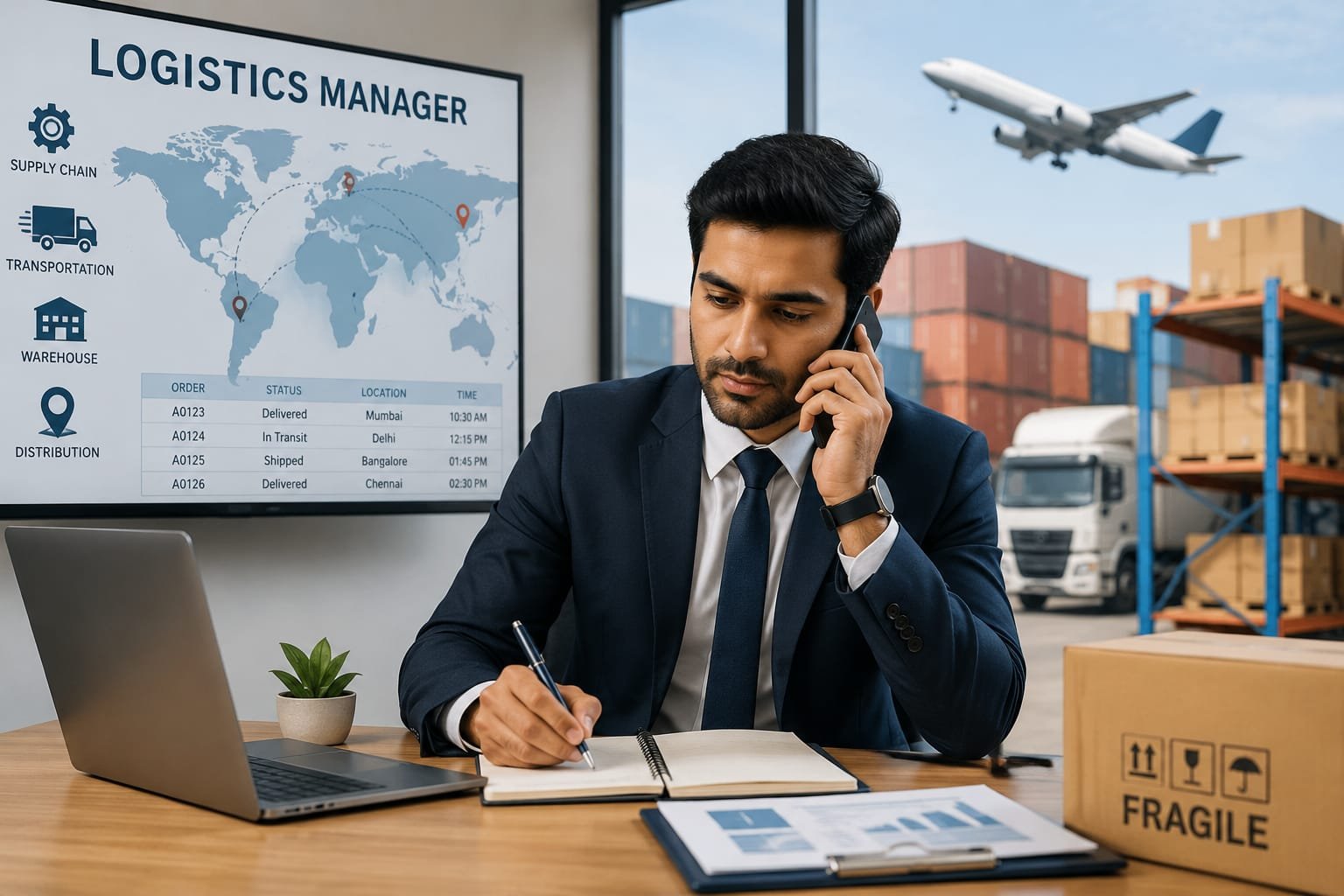
- The person who does all these activities is a Logistics Manager.
- 👉 In simple words: Logistics Managers help move goods and products safely from one place to another.
Logistics Manager
What Do They Do?
🎓 How to Become a Logistics Manager
The courses to pursue this career are given below :
These logistics and supply chain programs help students learn transportation systems, warehouse management, inventory handling, shipping operations, and business logistics skills.
BBA in Logistics & Supply Chain Management
Duration: 3 Years
Eligibility: Class 12 Pass from any stream
Entrance Exam: CUET or university-specific entrance exams
B.Com in Supply Chain Management
Duration: 3 Years
Eligibility: Class 12 Pass (Commerce preferred)
Entrance Exam: CUET / Merit-Based Admission
BBA in Logistics Management
Duration: 3 Years
Eligibility: Class 12 Pass from any stream
Entrance Exam: CUET or university-specific entrance exams
Bachelor of Logistics & Transportation Management
Duration: 3 – 4 Years
Eligibility: 12th Pass from a recognized board
Entrance Exam: University Entrance Test / Merit-Based Admission
Note: After 12th logistics courses mainly focus on supply chain systems, transportation planning, warehouse operations, inventory control, and business management skills.
These advanced logistics and supply chain programs help students learn transportation systems, warehouse operations, international shipping, inventory planning, and business management skills.
MBA in Logistics & Supply Chain Management
Duration: 2 Years
Eligibility: Graduation from a recognized university
Entrance Exam: CAT / MAT / CMAT / XAT / University MBA Entrance Exams
MBA in Operations & Supply Chain Management
Duration: 2 Years
Eligibility: Graduation from a recognized university
Entrance Exam: CAT / MAT / CMAT / XAT / University MBA Entrance Exams
PG Diploma in Logistics & Supply Chain Management
Duration: 1 Year
Eligibility: Any Graduation Degree
Entrance Exam: Merit-Based Admission / Institute-Level Entrance Tests
Note: After graduation logistics programs mainly focus on supply chain planning, transportation systems, warehouse management, inventory control, and business operations management.
These certification programs help students learn practical logistics operations, warehouse handling, transportation management, inventory control, and supply chain management skills.
Certificate Course in Shipping, Logistics and Supply Chain Management
Duration: 6 Months
Eligibility: Graduates in any field OR Diploma holders with minimum 3 years of experience
Provider: Indian Institute of Management Mumbai
Supply Chain Management Professional Certification (SCMPro)
Duration: 30 Hours
Eligibility: Open to professionals
Provider: CII and CODE–IIT Madras
APICS Certified in Logistics, Transportation and Distribution (CLTD)
Duration: Self-paced
Eligibility: No specific educational qualification required
Provider: Association for Supply Chain Management (ASCM)
Certificate Course on Supply Chain Management (Transportation, Logistics and Warehousing)
Duration: 120 Hours
Eligibility: 12th Pass, ITI or Diploma
Provider: Reliance Foundation Skilling Academy
Note: These certification courses mainly focus on logistics planning, warehouse operations, transportation systems, inventory tracking, and practical supply chain management skills.
Note:
(Age limits, marks, and admission process may vary depending on the college or state.
Below are some colleges that offer these courses.
These courses are available in many colleges and universities across India. You can choose colleges based on your location, budget, and entrance exams.)
🏛️ Colleges offering these courses in India
(Tap on a college to view the details)
After Class 12
CMR University, Bengaluru, Karnataka Symbiosis Skills and Professional University (SSPU), Pune, Maharashtra Indian Maritime University (IMU) K.P.B. Hinduja College of Commerce, Mumbai, Maharashtra Sree Narayana Guru College, Coimbatore, Tamil Nadu College of Applied Science, Kathikappally (IHRD), Alappuzha, Kerala Sri Sri University, Cuttack, OdishaAfter Graduation
Indira Gandhi National Open University (IGNOU), New Delhi, Delhi Pondicherry University, Puducherry Indian Maritime University (IMU), Chennai, Tamil Nadu Symbiosis Skills and Professional University (SSPU), Pune, Maharashtra Indian Institute of Management (IIM), Mumbai, Maharashtra ITM Business School, Navi Mumbai, Maharashtra Manipal Academy of Higher Education (MAHE), Manipal, Karnataka Amity University (Online), Noida, Uttar PradeshSTEP 1
Imagine you are working as a Logistics Manager in a company.
STEP 2
A customer orders a product online from another city.
STEP 3
You check the order details and arrange transportation and delivery.
STEP 4
You coordinate with warehouses, drivers, and delivery teams to make sure the product reaches on time.
STEP 5
The customer feels happy after receiving the product safely and quickly.
STEP 6
If you enjoy planning, organizing, and managing deliveries, this career may suit you.
Where do Logistics Managers work? (Job Roles + Growth)
Logistics Managers work in : Logistics and supply chain companies, Warehouses and distribution centers, e-commerce companies, Manufacturing plants, Retail companies, Shipping and freight companies, Ports and airports, and Transport and delivery companies.
🟢 Beginner Roles
Logistics Coordinator
(After BBA in Logistics & Supply Chain Management)
Tracks shipments and helps products reach customers on time.
Inventory Planner
(After B.Com in Supply Chain Management)
Monitors stock levels and manages warehouse inventory.
Transport Executive
(After Diploma in Logistics)
Manages vehicle movement and delivery schedules.
Warehouse Assistant
(After Certificate / Diploma Course)
Handles storage, packing, and product dispatch operations.
🔵 Mid-Level Roles
Warehouse Operations Manager
(After PG Diploma + Experience)
Manages warehouse staff and oversees daily operations.
Logistics Analyst
(After Executive Certification + Experience)
Studies shipping data and improves delivery efficiency.
Supply Chain Executive
(After Graduation + Experience)
Coordinates suppliers, transport, and warehouse systems.
Import & Export Executive
(After Logistics Specialization)
Handles international shipping and customs procedures.
🟣 Advanced Roles
Supply Chain Manager
(After MBA in Logistics & Supply Chain Management)
Oversees the complete supply and delivery network of a company.
Distribution & Transportation Director
(After CLTD Certification + Experience)
Manages large transportation systems and global shipping routes.
Operations Manager
(After MBA + Industry Experience)
Supervises company operations, logistics teams, and business performance.
International Shipping Companies
Manage global cargo movement, shipping routes, and international deliveries.
Air Cargo & Airline Logistics
Handle airport cargo operations and worldwide transportation systems.
Global E-Commerce Companies
Manage warehouse operations and fast product deliveries across countries.
Manufacturing & Supply Chain Companies
Coordinate suppliers, factories, warehouses, and product distribution worldwide.
Freelance & Remote Logistics Consulting
Help companies improve transport and supply systems remotely.
(Click Yes or No for each question)
1. When you order a product online, have you ever wondered how it reaches your home?
2. Are you interested in learning how products are transported from one place to another?
3. Do you enjoy planning and organizing things in your daily life?
4. Imagine you are working as a Logistics Manager for an e-commerce company.(eg.Amazon) The company has many orders to deliver to customers in different cities. You plan how the products should be packed, transported, and delivered on time. You coordinate with the warehouse and delivery teams to make sure everything goes smoothly. Finally, the products reach the customers on time. Do you like this type of work?
5. A warehouse is where a company stores its products. Products are transferred to the warehouse using big trucks. One day, a truck has a problem and the delivery is getting delayed. You need to find another way to move the products. You talk to the transport and warehouse teams and make a new plan. Finally, the products reach the warehouse without much delay. Does this type of work interest you?